EV Charger Installation Cost: 2026 Homeowner’s Guide to Pricing and Hidden Expenses
EV charger installation cost can vary from a relatively simple electrical job to a major home-infrastructure project. The charger itself is only one part of the bill. Wiring distance, panel capacity, labor, permits, installation location, trenching, and electrical upgrades can have a greater effect on the final price than the EVSE model you choose.
For a typical U.S. residential Level 2 project, current published estimates vary considerably. EnergySage currently reports a broad $800–$3,000 range depending on the home’s electrical setup. Other 2026 market sources place straightforward installations in narrower ranges, but those figures should be treated as estimates rather than guaranteed prices.
The most useful way to budget is therefore not to ask for one national average. It is to identify which installation scenario matches your property.
The Real Cost Equation
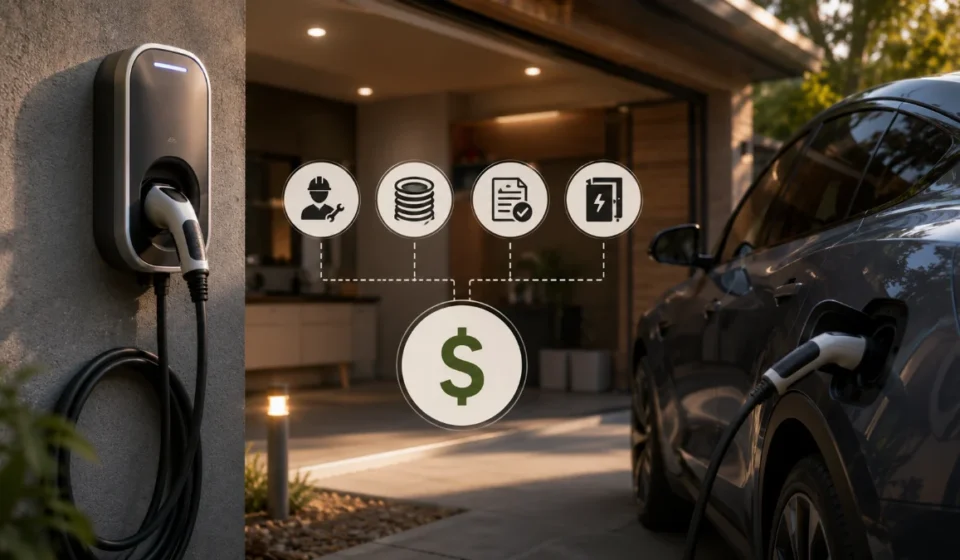
A practical budget can be broken into six categories:
Total installed cost = EVSE + electrical materials + labor + permits/inspection + site work + electrical upgrades
A simple garage project may involve only the first four. A detached-garage installation may add trenching. An older home with limited service capacity may add a panel or service upgrade.
| Cost component | What you are paying for |
| EVSE | Charging equipment, cable, mounting hardware |
| Electrical materials | Breaker, conductors, conduit, receptacle if applicable |
| Labor | Electrician assessment and installation |
| Permit/inspection | Local approval and inspection where required |
| Site work | Trenching, wall access, restoration, mounting |
| Capacity upgrades | Load management, panel, subpanel, or service work |
This is why two homeowners can buy identical EVSE models and receive dramatically different quotes.
What Does a Typical Installation Cost in 2026?
There is no authoritative single U.S. price that applies to every property.
EnergySage’s June 2026 guide reports $800–$3,000 for EV charger installation, depending on the home’s electrical setup.
A separate 2026 installer guide estimates roughly $1,200–$2,500 for a standard residential Level 2 installation under assumptions such as an existing 200-amp panel with capacity and a reasonably short route.
These ranges illustrate an important point: the condition of the property matters more than a generic average.
A useful scenario-based budget
| Installation situation | Relative complexity | What usually changes the price |
| Suitable existing 240V setup | Low | Equipment and connection requirements |
| Short new circuit in attached garage | Low–moderate | Labor, breaker, conductors, permit |
| Long route through finished areas | Moderate | Wire, conduit, access, labor |
| Detached garage | High | Trenching, conduit, restoration, distribution |
| Limited electrical capacity | High | Load management, panel, or service work |
| Multiple commercial chargers | Very high | Utility, civil, networking, capacity, maintenance |
These are project categories rather than guaranteed prices. Local labor rates and property conditions can move the final quote substantially.
The Charger Is Not Always the Expensive Part
Homeowners often start by comparing $300, $500, or $800 EVSE models. That is useful, but it does not tell you the total project cost.
A relatively inexpensive charger can still produce an expensive installation if:
- The panel is far from the parking area.
- The wiring route is difficult.
- The property requires trenching.
- The service has limited capacity.
- A panel or service upgrade is needed.
- Permitting is more involved.
Conversely, a more expensive smart EVSE may have relatively little effect on the total price when the electrical installation itself is straightforward.
What Makes a Quote Go Up?
Four factors deserve particular attention: distance, access, electrical capacity, and site complexity.
1. Distance from the electrical panel
A charger installed close to the panel is usually easier than one located at the opposite end of a house.
Longer routes can require:
- More conductors
- More conduit
- Additional supports
- More labor
- Wall or ceiling access
- Exterior weatherproofing
The physical route can therefore matter more than the EVSE’s advertised power.
2. Access to the wiring route
An electrician may have a straightforward job in an unfinished garage but a very different job when conductors have to pass through finished walls or difficult crawlspaces.
If access requires opening or restoring finished surfaces, labor can increase.
3. Electrical capacity
A home needs enough calculated electrical capacity for the additional EV charging load.
An electrician may find that the best solution is:
- Lower charging output
- Load management
- A subpanel
- Panel replacement
- Service upgrade
Do not assume that an empty breaker slot means the service has sufficient capacity.
4. Detached or outdoor locations
A detached garage or remote parking area can introduce:
- Trenching
- Underground conduit
- Additional electrical distribution
- Longer wire runs
- Restoration
- Outdoor-rated equipment
- Physical protection
That can change a simple electrical installation into a broader construction project.
How Much Does the Electrical Upgrade Matter?
Electrical upgrades can be one of the largest variables in a project.
A service upgrade is fundamentally different from simply adding a breaker. A panel replacement changes distribution equipment; increasing service capacity may involve additional equipment and utility coordination.
The correct solution should follow a load assessment.
A lower-output charger or managed charging system may sometimes provide sufficient charging without a major upgrade. That can be particularly useful when the homeowner has large existing electrical loads.
Why load management deserves a closer look
Suppose a home has electric heating, air conditioning, an electric water heater, and another large appliance. Adding a high-output EV charger can create a capacity problem during periods when several loads operate simultaneously.
A compatible energy-management system may be able to reduce EV charging power temporarily when household demand rises.
This does not mean load management is always better than upgrading the service. It means homeowners should understand all viable options before accepting a large upgrade quote.
How Your Charging Needs Affect the Budget
Don’t pay for charging speed that does not solve a real problem.
DOE estimates Level 1 at roughly 2–5 miles of range per hour and Level 2 at approximately 10–30 miles per hour, depending on equipment and vehicle.
Consider two households.
Household A: Drives 30 miles per day and parks for 12 hours.
Household B: Drives 100 miles per day and has only six hours overnight.
Household B has a stronger case for higher charging power. Household A may have enough time to recover its daily energy requirement with a more modest system.
This is why the highest-amperage EVSE is not automatically the most economical choice.
How to Compare Electrician Quotes
A low quote is only useful if it covers the same work as a competing quote.
Ask each electrician to specify:
- Exact EVSE model
- Hardware included or excluded
- Circuit configuration
- Breaker
- Wiring route
- Conduit
- Receptacle or hardwired connection
- Panel work
- Permit fees
- Inspection responsibility
- Wall repair
- Trenching
- Restoration
- Equipment mounting
- Final configuration
- Labor warranty
- Exclusions
A quote that says “EV charger installation — $600” is difficult to compare.
A detailed quote might explain that the price includes a specified circuit, a defined wire route, mounting, permit, inspection, and commissioning. That makes the number much more meaningful.
Ten Questions to Ask Before Accepting a Quote
- Was the price based on an actual site visit?
- Was electrical capacity evaluated?
- Is the charger included?
- Is the circuit included?
- Are permit and inspection fees included?
- Is the wire route defined?
- Is wall repair included?
- Is trenching included?
- What happens if unexpected electrical work is discovered?
- What warranty applies to the installation?
These questions can expose the difference between a genuinely inexpensive project and a quote that simply excludes important work.
What About the Cost of a 240V Outlet?
A homeowner may already have a 240V receptacle near the vehicle. That can change the installation scope, but it should not automatically be treated as a ready-to-use EV charging connection.
The receptacle, wiring, breaker, grounding, circuit rating, condition, and suitability for continuous EV charging all need to be evaluated.
If everything is already suitable and the EVSE is designed for that connection, the project can be much simpler than installing an entirely new circuit.
Hardwired vs. Plug-In Cost
Plug-in equipment can sometimes reduce installation complexity when a suitable receptacle already exists.
But installing a new receptacle still involves electrical work. A hardwired system can also be straightforward when the electrician is already installing a new dedicated circuit.
The choice should be based on:
- EVSE design
- Desired charging output
- Existing electrical conditions
- Portability
- Local requirements
- Future plans
Do not choose a connection method solely because it appears cheaper online.
What About Permits?
Permit requirements depend on the local authority.
Some jurisdictions require electrical permits and inspections for residential EV charging installations. Others have different processes or exemptions.
Ask the electrician:
- Who obtains the permit?
- Is the fee included?
- Who schedules inspection?
- What happens if an inspector requests changes?
- Is the quoted price inclusive of required compliance work?
Treat permitting as part of the installation scope rather than an afterthought.
Current Federal Tax-Credit Reality in 2026
This is one area where older EV charging articles can become misleading quickly.
The IRS states that the federal Alternative Fuel Vehicle Refueling Property Credit under Section 30C for individuals applies to qualifying property placed in service through June 30, 2026. For qualifying residential property, the credit was 30% of cost up to $1,000 per item, subject to eligibility requirements including location restrictions.
Because it is now August 2026, a homeowner planning a new installation should not subtract that federal credit from today’s budget without confirming current eligibility.
State, utility, and local programs can have separate rules and deadlines.
Commercial Installation Costs Are a Different Calculation
Commercial charging should not be budgeted like a single home Level 2 charger.
A commercial project may require:
| Cost category | Examples |
| Electrical infrastructure | Service, distribution, transformer, switchgear |
| Civil work | Trenching, concrete, foundations, bollards |
| Charging hardware | Multiple ports, higher output |
| Utility coordination | Service changes, interconnection |
| Software | Networking, access control, payment |
| Operations | Electricity, maintenance, repairs |
| Expansion | Spare conduit and future capacity |
DC fast charging can require particularly substantial infrastructure.
For a business, the financial question should include utilization, electricity tariffs, demand charges, maintenance, uptime, and future expansion—not merely the purchase price of the charger.
How to Reduce Unnecessary Installation Expense
The best savings usually come from better planning, not cheaper electrical work.
Right-size the charger
Don’t pay for charging capacity your vehicle cannot use or your driving routine does not require.
Choose the location intelligently
A slightly different mounting position may reduce wiring distance while still keeping the cable convenient.
Ask about alternatives to a service upgrade
If capacity is limited, ask whether lower charging output or managed charging is technically appropriate.
Plan future work before excavation
For detached garages or long underground routes, discuss future EV capacity before the trench is closed.
Compare detailed quotes
Get multiple quotes with identical scope wherever practical.
Avoid false economies
Do not sacrifice qualified electrical work, appropriate protection, permitting, or suitable equipment to save a relatively small amount upfront.
Read more: EV Charger Installation Cost: Homeowner’s Guide to Pricing and Hidden Expenses
Frequently Asked Questions
What is the average EV charger installation cost?
Current U.S. estimates vary widely. EnergySage reports roughly $800–$3,000 depending on electrical conditions, while other 2026 sources give narrower ranges for straightforward Level 2 installations. A property-specific quote is more useful than assuming one national average.
Does the charger price include installation?
Not necessarily. EVSE hardware and electrical installation are often separate costs. Always confirm whether the quote includes equipment, labor, materials, permits, and commissioning.
What is usually the biggest installation expense?
For a simple project, labor and electrical materials may dominate. For complex properties, panel/service work, trenching, or difficult wiring routes can become the highest cost.
Can an existing 240V outlet reduce installation cost?
Potentially, if it is correctly installed, suitably rated, in good condition, and appropriate for the intended EVSE and continuous load. An electrician should verify it first.
Does a longer wire run make EV charger installation more expensive?
Usually. Longer routes generally require more material and labor, and difficult access can increase the cost further.
How much does a panel upgrade add?
There is no universal price because panel work varies by property, equipment, local labor, and whether the service itself must be upgraded. Treat it as a separate project component rather than applying a single national number.
Can load management reduce installation cost?
In some homes, yes. A properly designed system can control EV charging when household demand rises and may avoid a larger electrical upgrade.
Should I buy the charger before getting an electrician quote?
It is usually better to determine the home’s electrical capability and desired charging configuration first. That reduces the risk of buying equipment that requires unnecessary upgrades.
Are EV charger installation permits included in quotes?
Sometimes. Never assume. Ask specifically whether the permit, application, inspection, and any required corrections are included.
Are federal EV charger tax credits still available in 2026?
The IRS states that the federal Section 30C credit for qualifying property placed in service at a main home applies through June 30, 2026. A new installation after that date should not automatically be treated as eligible.
Final Verdict
The smartest way to control EV charger installation cost is to price the entire electrical project rather than the charger alone. Start with your vehicle and charging needs, have the home’s electrical capacity assessed, compare detailed scopes, and verify current incentives before subtracting them from the budget.