SMCI Stock Price: Latest Price, Earnings, Forecast and Key Risks
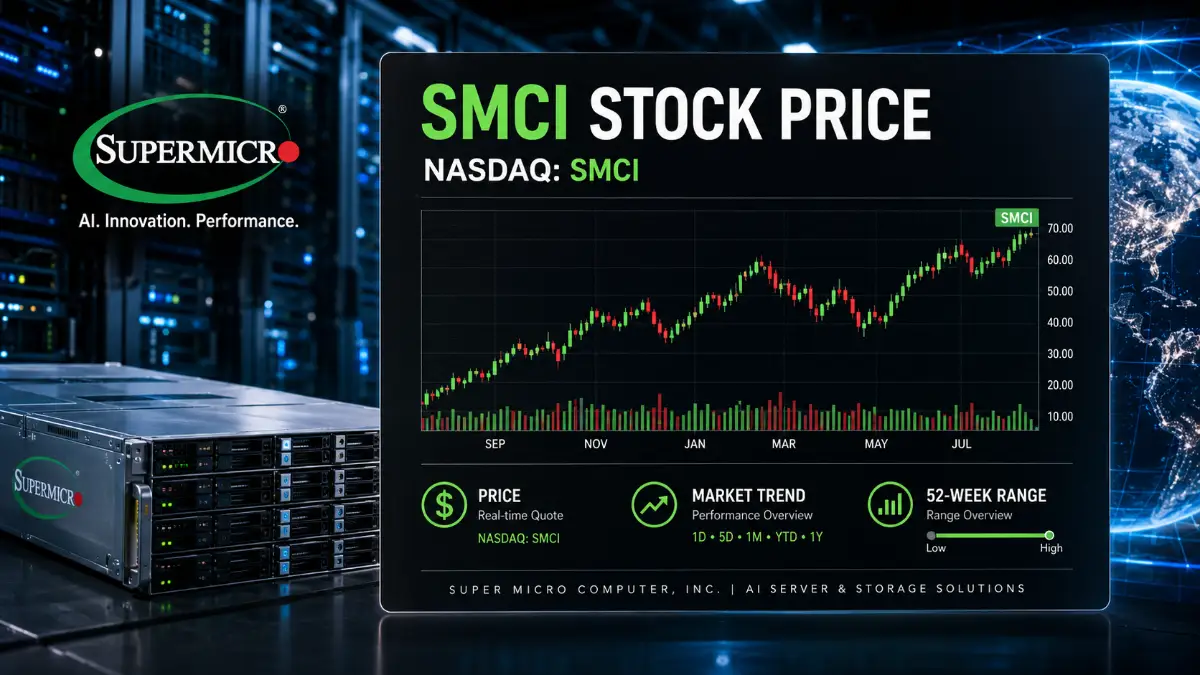
The SMCI stock price closed at $40.63 on August 13, 2026, according to the latest reported regular-session market data, after rising about 8% and extending a five-session rally of roughly 41%. The move came after Super Micro Computer reported fiscal fourth-quarter results that beat profit expectations and issued a much stronger fiscal 2027 revenue outlook.
For investors searching for the SMCI stock price, the bigger story is what caused the repricing. Supermicro missed the Wall Street revenue estimate for the quarter, but its profitability was much stronger than expected. More importantly, management projected fiscal 2027 revenue of $65 billion to $72 billion, well above the roughly $52.5 billion analyst expectation reported by Reuters.
That creates a more complicated investment picture than a simple post-earnings rally. Supermicro has exceptional AI-infrastructure demand and a large order pipeline, but investors still need to determine whether the company’s recent margin improvement can persist and whether those orders can be converted into revenue and cash flow at the expected pace.
SMCI Stock Price Summary
The latest completed regular trading session provides the cleanest reference point for the current market discussion.
| Metric | Latest reported figure |
| August 13, 2026 close | $40.63 |
| Approx. daily gain | 8% |
| Previous close | About $37.61 |
| 52-week high | $58.78 |
| 52-week low | $19.48 |
| Recent five-session gain | About 41% |
| Exchange | Nasdaq |
| Ticker | SMCI |
The price is time-sensitive. Nasdaq provides real-time SMCI quote information, so readers checking the stock during a trading session should use the live market quote rather than treating the August 13 close as today’s price.
This distinction matters because Supermicro has been moving quickly around earnings. The stock’s August 12 gain alone was reported at more than 13%, while the following session added another 8%.
Read Also: Cast of Best Medicine – Meet the Actors, Characters and Roles Behind the Series
Why the SMCI Stock Price Jumped After Earnings
The latest rally was driven by a combination of three things: stronger profitability, an unusually large forward revenue forecast, and evidence that AI infrastructure demand remains powerful.
The quarterly revenue number itself was not the main reason for the rally.
Supermicro reported approximately $11.12 billion in fiscal Q4 revenue, compared with about $5.8 billion a year earlier. Analysts had expected roughly $11.55 billion, meaning the company did not beat the revenue estimate.
What changed investor sentiment was the quality of the earnings underneath that revenue.
Supermicro reported adjusted earnings of approximately $1.70 per share, compared with an analyst expectation around $0.92-$0.94. Gross margin also reached approximately 17.5%-17.6%, considerably above the company’s earlier expectations.
That combination told the market something important: Supermicro was not merely growing sales. In the latest quarter, it was generating considerably more profit from those sales than investors had feared.
Q4 FY2026 numbers investors should know
| Fiscal Q4 FY2026 metric | Reported result |
| Revenue | $11.12 billion |
| GAAP gross margin | About 17.5% |
| Adjusted gross margin | About 17.6% |
| Non-GAAP diluted EPS | $1.70 |
| Prior-year revenue | About $5.8 billion |
| Prior-year non-GAAP EPS | About $0.41 |
The margin result was particularly notable because Supermicro had previously guided to a much lower gross-margin range of approximately 8.2%-8.4%. In July, the company had already raised its preliminary expectation to 15%-17%, citing favorable customer and product mix. The final Q4 result landed around the upper end or above that preliminary range.
That is why the latest SMCI stock price reaction cannot be understood by looking at revenue alone.
Read Also: Full Size Mattress in a Small Room – Smart Space-Saving Tips & Layout Ideas
Fiscal 2027 Guidance Is the Bigger Story
The most important number in Supermicro’s latest report may not be the Q4 revenue figure at all.
Management expects fiscal 2027 revenue of $65 billion to $72 billion. Reuters reported that this was substantially above Wall Street’s average expectation of approximately $52.5 billion.
That gap matters because stock prices reflect expectations about future earnings rather than simply the quarter that has already ended.
If Supermicro reaches the lower end of its forecast, the company would still be operating at a significantly larger revenue scale than analysts had previously modeled. If it reaches the upper end, the difference becomes even more substantial.
Supermicro reported approximately $39.1 billion in fiscal 2026 revenue, so the new fiscal 2027 outlook implies another major step up in sales. The forecast therefore gives investors a new framework for thinking about the company’s future earnings power.
The next-quarter guide is also important.
The annual forecast gets most of the attention, but the immediate fiscal Q1 2027 outlook deserves equal consideration.
Supermicro guided to:
- Revenue of $14.5 billion to $15.5 billion
- Adjusted EPS of $1.01 to $1.10
- Gross margin of approximately 10.4% to 10.8%
The quarterly revenue forecast was well above the roughly $11.8 billion analyst expectation reported around the earnings release.
That creates an interesting tension.
Q4 gross margin was approximately 17.6%, but management expects a much lower margin in the following quarter. Investors should therefore avoid assuming that the Q4 margin represents a permanent new baseline.
For the SMCI stock price, the next earnings report could be particularly important because it will show whether the company can simultaneously deliver the expected revenue acceleration and maintain acceptable profitability.
What Is Driving Supermicro’s Growth?
Supermicro is a major provider of server and data-center infrastructure used in AI, cloud computing, enterprise workloads, and other high-performance applications. Its business benefits from the rapid expansion of computing capacity required by generative AI and other accelerated-computing workloads.
The company’s opportunity is tied to more than just GPU demand.
AI data centers require complete infrastructure around those processors, including servers, storage, networking, power management, and cooling. Supermicro’s ability to package those components into deployable systems gives it exposure to the broader infrastructure buildout.
Recent company updates indicate that demand has been exceptionally strong. Supermicro said its fiscal Q4 new orders exceeded $60 billion, resulting in a record backlog entering fiscal 2027.
The company also reported that nine customers generated more than $1 billion each in fiscal 2026, compared with four such customers in the previous year. Reuters cited this expansion in the customer base as another sign of growing scale.
However, a large order figure needs to be interpreted carefully.
An order is not the same thing as recognized revenue.
A customer can place an order today while the actual system is manufactured, delivered, installed, and accepted later. Large AI data-center projects can also be affected by power availability, cooling systems, networking infrastructure and construction schedules.
That is particularly relevant because Supermicro said customer delays involving power, cooling and networking affected the timing of some Q4 business.
The $60 Billion Order Figure Needs Context
The $60 billion-plus order figure is one of the strongest bullish signals surrounding the company, but it should not be interpreted as a guaranteed $60 billion of near-term sales.
Think of the number as evidence of customer demand rather than booked revenue that has already passed through the income statement.
For investors, the important follow-through will be visible in several places:
- Revenue growth.
- Backlog conversion.
- Accounts receivable.
- Inventory.
- Operating cash flow.
- Gross margin.
- Customer concentration.
- Delivery timing.
This distinction is one of the most important parts of evaluating the SMCI stock price after the earnings rally.
If orders convert into revenue while margins remain healthy, the bullish thesis becomes stronger.
If orders grow but cash flow deteriorates, inventory rises sharply, or customers repeatedly delay deployments, the market may become less enthusiastic even if headline demand remains strong.
Read Also: Tokyo Ghoul Manga – Complete Story, Reading Order, Characters & Ending Explained
SMCI Stock Price Volatility Has Been Significant
The recent rally looks dramatic partly because the stock had already experienced substantial swings before earnings.
Market data showed SMCI reaching a 52-week high of $58.78 and a low of $19.48 around the latest reporting period.
That range illustrates the central characteristic of this stock: expectations can change quickly.
In July, for example, the shares moved from the mid-$20s into the low-$30s in a matter of days. On July 22, SMCI gained nearly 20% in one session, while later trading again pulled the stock lower.
This history makes it dangerous to interpret a single rally as proof of a permanent change in valuation.
The current move is supported by real fundamental developments, particularly the stronger earnings outcome and forward guidance. But the market still needs several quarters of execution before investors can know whether those improvements are durable.
What Analysts Are Saying About SMCI
Analyst expectations remain more complicated than the recent share-price momentum might suggest.
Several firms raised their targets after the earnings report, but some maintained neutral or cautious ratings. MarketWatch reported that Citi and Goldman Sachs both raised targets while retaining cautious views, reflecting concerns around customer timing, working capital, competition,n and margin sustainability.
Raymond James, meanwhile, raised its target to $48, according to Barron’s.
The important lesson is that a higher price target does not necessarily mean an analyst has become bullish.
An analyst can raise a target because earnings estimates have increased while still believing that the risk-adjusted return is limited.
For that reason, investors should look at the following four items separately:
| Analyst measure | Why it matters |
| Rating | Shows the analyst’s overall stance |
| Price target | Shows the analyst’s valuation estimate |
| Earnings estimate | Indicates expected fundamental performance |
| Target date | Determines how long the valuation assumption applies |
Price targets are estimates, not promises. They can change rapidly after new earnings, guidance, regulatory developments, or major industry announcements.
The Bull Case for SMCI
The bullish case starts with the scale of AI infrastructure spending.
If major cloud providers, technology companies and AI developers continue expanding data-center capacity, Supermicro has a direct opportunity to participate in that investment cycle.
The company’s fiscal 2027 guidance provides a stronger foundation for that argument than the AI theme alone.
Revenue could scale faster than expected.
Management’s $65 billion-$72 billion fiscal 2027 forecast is substantially higher than the previous Wall Street expectation.
If Supermicro achieves that range, the company will have demonstrated that the current AI infrastructure cycle is translating into much larger business volumes.
The order pipeline provides visibility.y
More than $60 billion in new Q4 orders gives the company a substantial demand pipeline. The figure does not guarantee revenue, but it provides evidence that customers are committing significant resources to future infrastructure deployments.
Profitability could improve
The Q4 gross-margin result provides another reason for optimism.
A 17.5%-17.6% margin was substantially better than earlier expectations. If Supermicro can keep margins structurally above the levels investors had feared, earnings growth could outpace revenue growth.
That would potentially make the stock more attractive than a simple low-margin hardware comparison suggests.
Customer diversification is improving.
The increase from four customers generating more than $1 billion in fiscal 2025 to nine in fiscal 2026 suggests that Supermicro’s revenue base is becoming broader. Reuters cited this development as part of the company’s recent growth.
Broader customer participation can reduce dependence on any single deployment cycle, although investors should continue monitoring concentration in future filings.
The Bear Case for SMCI
The bearish argument does not require believing that AI demand will disappear.
Instead, it centers on whether Supermicro can turn that demand into sustainable earnings without encountering margin pressure, delivery delays, or excessive financing requirements.
Margin normalization
The most obvious warning sign is the gap between Q4’s roughly 17.6% adjusted gross margin and the 10.4%-10.8% range guided for fiscal Q1 2027.
If margins move substantially lower, the market may conclude that Q4 was unusually favorable rather than evidence of a permanent structural improvement.
Customer and infrastructure delays
AI server deployments depend on infrastructure outside Supermicro’s direct control.
Power availability, cooling, networking, and data-center construction can all delay installations. A delay does not necessarily destroy demand, but it can shift revenue from one quarter to another and make financial results harder to predict.
Working-capital pressure
Rapid growth can require substantial investment in inventory and receivables.
That means investors should not evaluate Supermicro only through revenue and earnings per share. Operating cash flow also matters.
If sales rise rapidly while cash remains tied up in inventory and receivables, the financial quality of that growth may be weaker than the income statement initially suggests.
Competition
Supermicro operates in a highly competitive infrastructure market that includes companies such as Dell Technologies and Hewlett Packard Enterprise.
As AI spending expands, competitors have an incentive to capture the same customers and infrastructure budgets. Strong industry growth does not guarantee that every supplier will maintain the same margins.
Export-Control Risk Still Matters
Export controls remain another factor investors should monitor, but this issue requires careful distinction between allegations involving individuals and actions against the company itself.
On March 19, 2026, the U.S. Department of Justice announced charges against three individuals over an alleged scheme involving the diversion of U.S.-assembled AI servers containing certain advanced GPUs to China. The DOJ identified Yih-Shyan “Wally” Liaw, Ruei-Tsang “Steven” Chang and Ting-Wei “Willy” Sun as defendants.
The important point for readers is that the cited government announcement concerned those individuals; it should not be rewritten as though Super Micro Computer, Inc. itself had been charged in that announcement.
The broader industry risk remains relevant because export restrictions can affect which products can be sold to particular markets, what compliance procedures are required, and how suppliers manage international customers.
Any future regulatory development should therefore be described precisely rather than generalized into a claim that the company itself has been charged.
What Could Move the SMCI Stock Price Next?
The next stage of the SMCI stock price story will depend on execution rather than another AI headline.
Q1 revenue versus guidance
The first major test is whether Supermicro can deliver within its $14.5 billion-$15.5 billion fiscal Q1 revenue range.
A result comfortably within or above that range would provide evidence that the current order pipeline is converting into sales. A significant miss could revive concerns about customer timing.
Gross margin
The second major test is profitability.
Investors will compare actual gross margin with management’s 10.4%-10.8% Q1 expectation. A materially stronger result could support the view that the Q4 improvement was not a one-off event.
Order conversion
The market will also want evidence that the more than $60 billion of new orders is translating into shipments and recognized revenue.
The key is not simply whether the backlog remains large. It is whether the backlog is being converted efficiently.
Read More: Explore More Trending Entertainment, Finance, Home & Lifestyle Guides
Cash flow
Operating cash flow deserves particular attention as the business scales.
Strong earnings accompanied by healthy cash generation would provide a stronger picture than earnings growth alone. Conversely, a sharp increase in working-capital requirements could limit the quality of the expansion.
Customer concentration
The increase in large customers is encouraging, but investors should continue watching how much revenue depends on individual customers or major projects.
Regulatory developments
Any significant change in U.S. export rules or enforcement could affect sentiment toward AI-server companies, particularly those with international customers and complex supply chains.
Is SMCI Stock a Buy After the Rally?
Whether the stock is attractive after the earnings move depends on what assumptions an investor is willing to make.
The bullish investor is effectively betting that Supermicro can deliver most of its fiscal 2027 revenue guidance, convert its large order pipeline into sales, maintain acceptable margins, and benefit from continued AI data-center investment.
The cautious investor sees a different set of probabilities.
The stock has already rallied sharply. Q4’s unusually strong margin may not repeat. The next-quarter margin guide is much lower. Large deployments can be delayed, and rapid growth can require significant working capital.
That makes the SMCI stock price particularly sensitive to execution.
Rather than asking only whether SMCI is “cheap” or “expensive,” investors should ask whether the current share price already assumes successful execution of the $65 billion-$72 billion fiscal 2027 outlook.
That is a more useful valuation question.
A strong AI market by itself is not enough. Supermicro must capture that demand at attractive economics.
What Investors Should Watch in the Next Earnings Report
The next report should be read through a short checklist rather than one headline number.
| What to watch | Why it matters |
| Revenue | Tests the fiscal 2027 growth trajectory |
| Gross margin | Tests whether Q4 profitability was sustainable |
| Adjusted EPS | Shows whether revenue growth is reaching the bottom line |
| Operating cash flow | Measures the quality of earnings |
| Inventory | Indicates whether growth is consuming working capital |
| Receivables | Helps assess cash conversion |
| Customer concentration | Shows dependence on major buyers |
| Backlog/orders | Provides visibility into future demand |
| Deployment commentary | Indicates whether power, cooling and networking delays are easing |
| Export-control developments | Identifies potential regulatory risk |
This framework is more useful than trying to predict a precise share price several months in advance.
The SMCI stock price will ultimately respond to the difference between what the market expects and what Supermicro actually delivers.
Frequently Asked Questions
What is the latest SMCI stock price?
The latest completed regular-session closing price discussed in this article is $40.63 on August 13, 2026. The stock is traded on Nasdaq under the ticker SMCI. Because market prices change continuously, readers should use a live quote for the current trading price.
Why did the SMCI stock price rise after earnings?
The rally followed stronger-than-expected profitability and a much higher forward revenue outlook. Supermicro reported adjusted Q4 EPS of $1.70 and forecast fiscal 2027 revenue of $65 billion-$72 billion.
Did Supermicro beat revenue expectations?
No. Fiscal Q4 revenue was approximately $11.12 billion versus an analyst expectation of about $11.55 billion. The positive reaction came largely from better profitability and stronger forward guidance.
What is Supermicro’s fiscal 2027 revenue guidance?
Management expects fiscal 2027 revenue of $65 billion to $72 billion, substantially above the roughly $52.5 billion Wall Street expectation reported by Reuters around the earnings release.
What is Supermicro’s fiscal Q1 2027 guidance?
The company expects fiscal Q1 revenue of approximately $14.5 billion to $15.5 billion and adjusted EPS of about $1.01 to $1.10. Management also guided to a gross margin of approximately 10.4%-10.8%.
How much did Supermicro report in new orders?
Supermicro said it received more than $60 billion in new orders during fiscal Q4 2026, contributing to a record backlog entering fiscal 2027. Those orders should not be treated as equivalent to already-recognized revenue.
What is SMCI’s 52-week high and low?
Recent market data put the 52-week range at approximately $19.48 to $58.78. Because a new trading session can change the range, this figure should be refreshed whenever the article is materially updated.
What do analysts expect from SMCI?
Analyst views remain mixed. Some firms raised price targets following the earnings release, while others maintained neutral or cautious ratings because of margin sustainability, customer timing, working-capital requirements, competition, and regulatory concerns.
What is the biggest risk to SMCI after earnings?
One of the biggest risks is that Q4’s approximately 17.5%-17.6% gross margin proves difficult to sustain. Management’s fiscal Q1 guidance of roughly 10.4%-10.8% shows why investors should not automatically extrapolate the Q4 margin.
When is Supermicro expected to report its next earnings?
Third-party earnings calendars have projected an early-November 2026 reporting window for fiscal Q1 2027, but the exact date should be confirmed through Supermicro’s investor-relations calendar before publication or an investment decision. Supermicro’s investor-relations site is the appropriate primary source for the final earnings schedule.
Final Takeaway
The current SMCI stock price reflects a meaningful change in investor expectations after Supermicro’s latest earnings report.
The company delivered approximately $11.12 billion of Q4 revenue, reported adjusted EPS of $1.70, produced gross margins around 17.5%-17.6%, and guided fiscal 2027 revenue to $65 billion-$72 billion. It also entered the new fiscal year with more than $60 billion in Q4 orders.
Those numbers make the bullish case much stronger than it was before earnings.
But they do not eliminate the central questions.
The next test is whether Supermicro can convert its large order pipeline into revenue while maintaining healthy margins and generating enough cash to support rapid growth. The gap between Q4’s strong margin and the lower Q1 margin guidance is especially important.
For anyone following the SMCI stock price, the most useful approach now is to watch revenue conversion, gross margin, cash flow, customer timing, backlog execution, and regulatory developments rather than relying on a single price target.
The earnings rally is significant. Whether it becomes a durable re-rating will depend on what Supermicro delivers over the next several quarters.