Ultrahuman Ring: 2026 Guide to AIR, PRO, Features, Price, Accuracy and Value
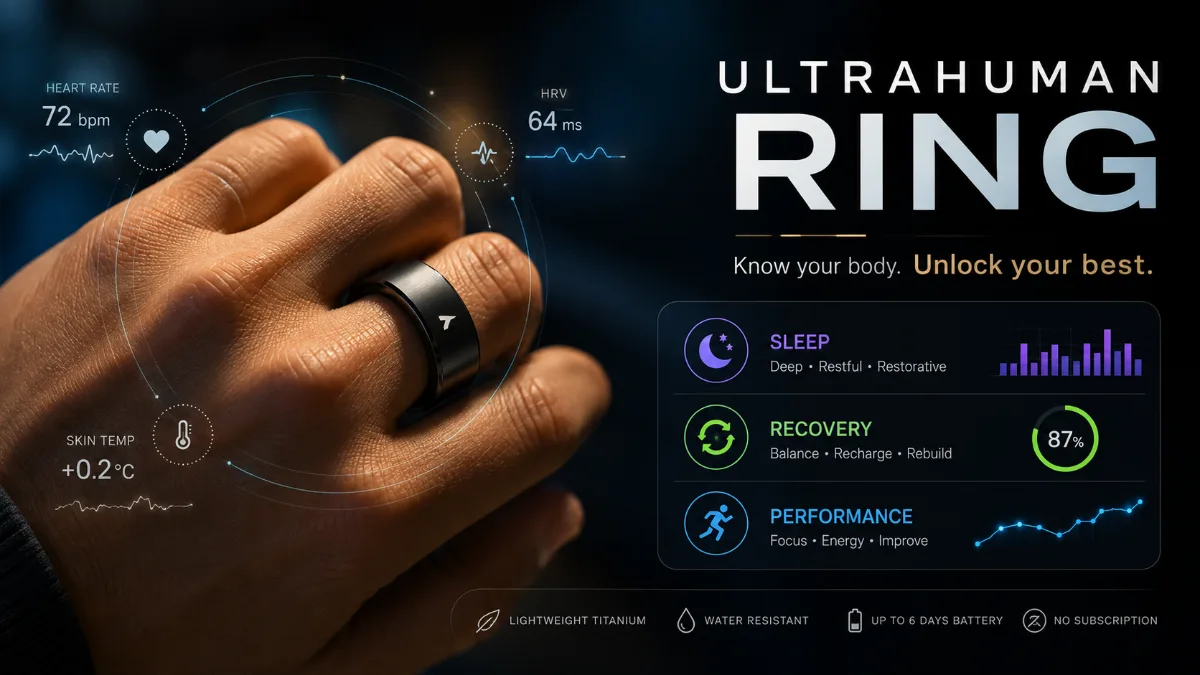
The Ultrahuman Ring is a screen-free smart ring designed for continuous health and wellness tracking, with a particular focus on sleep, recovery, heart rate, HRV, temperature trends and everyday movement. In 2026, the lineup includes Ring AIR and Ring PRO, giving buyers a choice between a lighter, lower-cost model and a more expensive model built around longer battery life, greater storage and a dedicated charging case.
The important question is not simply whether the Ultrahuman Ring has impressive specifications. It is whether those measurements and insights fit the way you actually live. AIR can make more sense for someone who wants the core ring experience without paying for premium hardware, while PRO is more compelling for frequent travelers, heavy wearable users and people who strongly dislike charging.
This guide explains what the Ultrahuman Ring is, what it tracks, how AIR and PRO differ, how accuracy should be interpreted, what ownership costs, how sizing works, and where the ring fits compared with Oura and smartwatches.
Quick Answer: What Is the Ultrahuman Ring?
The Ultrahuman Ring is a screen-free wearable built for passive health and recovery tracking. It is most useful for people who want overnight sleep information, recovery trends, heart-rate and HRV data, temperature trends and other wellness signals without wearing a screen on the wrist. Ring AIR is the lighter and less expensive option, while Ring PRO adds a much longer claimed battery life, more on-ring storage and a PRO Charging Case.
What Is the Ultrahuman Ring?
Unlike a smartwatch, the Ultrahuman Ring is designed to stay in the background. It has no display, GPS interface or notification screen competing for attention. Its value comes from collecting passive measurements while you work, sleep, travel or go about your normal day.
That makes the ring particularly useful as a complement to a smartwatch rather than an automatic replacement. A watch is usually better for live workout information, GPS, navigation and on-screen interaction. A ring is better suited to discreet overnight wear and continuous passive monitoring.
What Does the Ultrahuman Ring Track?
· Sleep duration, timing and sleep-related trends
· Heart rate and heart-rate trends
· Heart-rate variability (HRV)
· Skin-temperature trends
· Movement and activity information
· Recovery-oriented metrics and readiness-style insights
· Additional wellness information through the Ultrahuman app and optional ecosystem services
The practical value is less about any single number and more about patterns. These are wellness signals, not a substitute for medical testing or professional diagnosis.
Ultrahuman Ring AIR vs Ring PRO
| Feature | Ring AIR | Ring PRO |
| U.S. listed price | $349 | $479 |
| India listed price | ₹28,499 | ₹44,999 |
| Weight | About 2.4 g | 3.3–4.8 g |
| Thickness | 2.4 mm | 2.65 mm, varies by size |
| Battery | 4–6 days | Up to 15 days |
| PRO Charging Case | No | Yes; up to 45 days case battery |
| On-ring storage | Up to 4 days | Up to 250 days |
| Water resistance | 100 m / 328 ft | 100 m / 328 ft |
| Processor | Single-core | Dual-core with on-chip ML |
| Sensors | Temperature, PPG, 6-axis IMU | Temperature, redesigned PPG, 6-axis IMU |
Manufacturer-listed specifications can change by region and over time. Battery performance also varies with settings and use.
Which Ultrahuman Ring Should You Buy?
· Choose AIR if you want the core sleep and recovery experience at the lower upfront price.
· Choose AIR if low weight is especially important to you.
· Choose PRO if charging interruptions are a major annoyance.
· Choose PRO if you travel frequently and want more on-ring storage.
· Choose PRO if the charging case and longer battery life are worth the premium.
· Do not choose PRO simply because it is newer; its main advantage is hardware, not a completely different software experience.
For many first-time buyers, AIR is the more rational starting point. PRO becomes easier to justify when its hardware advantages solve a real problem.
How Accurate Is the Ultrahuman Ring?
Accuracy should be judged metric by metric. Consumer wearables can be useful for observing trends without matching clinical equipment or laboratory measurements.
Independent reviews have raised concerns about activity and step tracking on Ring PRO. That matters if your main reason for buying a ring is highly dependable daily activity counting. If your priority is sleep, recovery and passive physiological trends, those limitations may matter less.
The safest way to use wearable data is to look for sustained changes rather than treating one unusual reading as proof that something is medically wrong.
Sleep, Recovery and HRV
Sleep is one of the easiest use cases to understand because the ring can remain on your finger overnight without the screen or wrist bulk of a smartwatch. Over time, you can compare sleep duration and timing with recovery-related trends.
Recovery is most useful when several signals move together. A change in sleep, HRV and resting heart rate may be more informative than any single recovery score. HRV is also best interpreted against your own baseline.
Does the Ultrahuman Ring Require a Subscription?
The core ring experience does not require a mandatory recurring subscription. Ultrahuman sells optional PowerPlugs and other services, so subscription-free should not be interpreted as every feature being free forever.
How Much Does the Ultrahuman Ring Cost?
Current manufacturer-listed pricing puts Ring AIR at $349 in the U.S. and ₹28,499 in India, while Ring PRO is listed at $479 in the U.S. and ₹44,999 in India. Prices can change, so check the official product page before purchasing.
· AIR: lower upfront cost and lighter hardware.
· PRO: higher upfront cost, but substantially longer battery life and a charging case.
· Optional services can add to ownership costs.
· Promotions and regional pricing can change the final amount you pay.
Is the Ultrahuman Ring Worth It?
For the right buyer, yes. The strongest case for the Ultrahuman Ring is not that it replaces every other wearable. It provides discreet, passive sleep and recovery information without requiring a mandatory core subscription.
AIR is easier to recommend to many first-time buyers because it delivers the core experience for less money and less weight. PRO makes more sense if you travel frequently, dislike charging or genuinely value its longer battery life, storage and charging case.
It is harder to recommend the ring to someone whose priorities are GPS, live pace, navigation, notifications, a screen or detailed workout controls. A capable sports watch may be the better tool for those needs.
Ultrahuman Ring vs Oura
Oura remains one of the most relevant alternatives. The biggest strategic difference is the ownership model: Ultrahuman’s core ring experience does not require a mandatory recurring subscription, while Oura uses a membership model for its full feature set.
· Choose Ultrahuman if avoiding recurring membership fees is a priority.
· Choose Ultrahuman PRO if long battery life and charging convenience matter heavily.
· Consider Oura if you prefer its established ecosystem and streamlined experience.
· Compare total ownership cost, not just purchase price.
Ultrahuman Ring vs Apple Watch or Garmin
· Ultrahuman Ring: strong for passive sleep and recovery tracking; no display, GPS or navigation.
· Smartwatch: generally stronger for GPS, live workout metrics, notifications, navigation and on-screen interaction.
· The ring is often a complement to a smartwatch rather than a replacement.
Ultrahuman Ring Sizing and Fit
Sizing deserves more attention than it gets in many buying guides. Do not assume your existing ring size will automatically fit the Ultrahuman Ring. Finger dimensions can change during the day and overnight.
· Use the official sizing kit when available.
· Wear the sample size long enough to judge comfort, not just for a few minutes.
· Check the fit during normal daily activity and overnight wear.
· Remember that PRO is heavier and thicker than AIR, so fit can feel different even at the same nominal size.
Is the Ultrahuman Ring Comfortable for All-Day Wear?
AIR is approximately 2.4 grams, while PRO ranges from 3.3 to 4.8 grams and is thicker. For many people, the ring’s small form factor is one of its main advantages, particularly for sleep. Comfort is personal, so sizing matters more than weight alone.
Is the Ultrahuman Ring Waterproof?
Ultrahuman lists both AIR and PRO with water resistance up to 100 meters / 328 feet. AIR’s published specifications also state a 12-hour limit under its stated conditions. Use the ring according to the manufacturer’s instructions for water exposure.
Jade by Ultrahuman
Jade is Ultrahuman’s AI layer designed to interpret longer-term information across the Ultrahuman ecosystem. It can help summarize patterns and explain changes instead of requiring every user to interpret a large dashboard of metrics.
Jade should still be treated as an interpretation and organization tool, not as a medical diagnostic system.
What About Ultrahuman’s U.S. Availability?
U.S. availability has changed over time, so older articles can be misleading. Ultrahuman announced U.S. Ring PRO pre-orders on March 24, 2026 following clearance from U.S. Customs and Border Protection. Check current availability for the exact model before ordering rather than relying on an older blanket statement about the brand.
Who Should Buy the Ultrahuman Ring?
· People who want screen-free sleep and recovery tracking.
· People who want passive health information throughout the day.
· People who already own a smartwatch but want a more discreet overnight wearable.
· People who dislike mandatory recurring subscriptions for core ring data.
· Data-oriented users who enjoy looking for long-term patterns.
Who Should Skip the Ultrahuman Ring?
· People whose main need is GPS.
· Runners or cyclists who need live pace and workout information on the device.
· People who rely heavily on smartwatch notifications or navigation.
· People who want a clinical diagnostic device.
· People who know that extensive health data makes them fixate on individual numbers.
Read more: Ultrahuman Ring: 2026 Guide to AIR, PRO, Features, Price, Accuracy and Value
Common Ultrahuman Ring Buying Mistakes
· Buying PRO just because it is the newest model.
· Ignoring sizing and overnight comfort.
· Treating every wearable measurement as clinically exact.
· Assuming subscription-free means every optional service is free.
· Expecting a ring to replace a GPS sports watch.
· Comparing only purchase price instead of total ownership cost.
Frequently Asked Questions
Is the Ultrahuman Ring worth it in 2026?
It is worth considering if you want passive sleep, recovery and wellness tracking without a mandatory subscription for the core experience. It is less suitable for GPS, live workouts or clinical monitoring.
What is the difference between Ring AIR and Ring PRO?
AIR is lighter and less expensive, with 4–6 days of claimed battery life. PRO costs more and adds up to 15 days of claimed ring battery life, more on-ring storage, a PRO Charging Case and newer hardware.
Does the Ultrahuman Ring have a monthly fee?
The core ring experience does not require a mandatory recurring subscription. Optional PowerPlugs and other services may involve additional charges.
How accurate is the Ultrahuman Ring?
Accuracy depends on the metric. Independent reviews have reported useful sleep information but also inconsistencies in activity and step tracking, so results are best interpreted as trends rather than clinical measurements.
Is Ring AIR still worth buying?
Yes. AIR remains the lower-cost, lighter route into the core Ultrahuman ring experience. PRO is easier to justify when battery life, storage and charging convenience are priorities.
How long does Ring PRO last?
Ultrahuman rates Ring PRO for up to 15 days under stated conditions. Turbo Mode is around 12 days and Chill Mode is more than 15 days; real-world results vary.
Is Ultrahuman better than Oura?
It depends on priorities. Ultrahuman’s subscription-free core experience and PRO battery are major advantages, while Oura may appeal to people who prefer its established ecosystem and membership model.
Can the Ultrahuman Ring replace an Apple Watch or Garmin?
No. It does not provide the same GPS, display, navigation or live workout functionality. It is often better viewed as a complement to a smartwatch.
Can you swim with the Ultrahuman Ring?
Both AIR and PRO are listed as water-resistant up to 100 meters / 328 feet under the manufacturer’s stated conditions. Follow the manufacturer’s instructions for water exposure.
Who should avoid the Ultrahuman Ring?
People who mainly need GPS, live sports information, navigation, notifications, or clinical measurements should consider another device.
Final Verdict
The Ultrahuman Ring is best understood as a passive health and recovery wearable, not a miniature smartwatch. Its strongest advantages are discreet overnight wear, a subscription-free core experience, and a growing set of health insights.
For most first-time buyers, Ring AIR is the value-oriented choice. Ring PRO is the better fit when long battery life, greater storage and the charging case solve real everyday problems. The main reasons to look elsewhere are equally clear: you need GPS, live workout controls, navigation, notifications, or more dependable activity counting.
The right buying decision therefore comes down to your priorities. If a small ring helps you consistently understand sleep and recovery, the Ultrahuman Ring can be a useful addition to your wearable setup. If you need an all-purpose sports and smartwatch interface, a smartwatch remains the better tool.