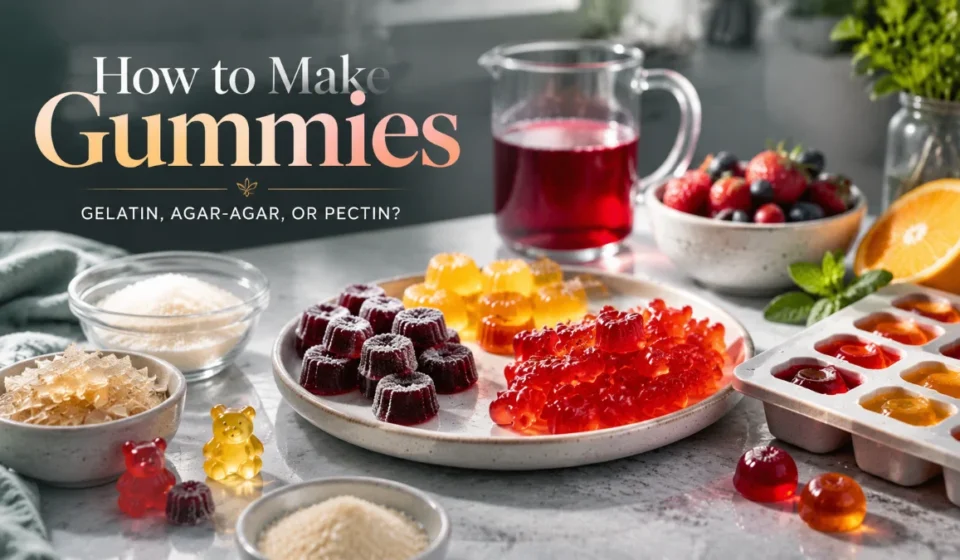
How to Make Gummies: Gelatin, Agar-Agar, or Pectin?
If you’re wondering how to make gummies, the gelling agent you choose determines much of the final texture. Gelatin gives the familiar elastic chew of classic gummy bears. Agar-agar produces a firmer plant-based gel, while pectin is especially useful for fruit-centered formulations-but pectin itself comes in different types with different requirements.
The important lesson is that these ingredients are not interchangeable powders. Each one has its own activation method, formulation requirements, and texture. Choose the gelling system first, then build the recipe around it.
Which Gelling Agent Should You Use?
| Your priority | Best starting point | Why |
| Classic chewy gummy bears | Gelatin | Most elastic, familiar gummy texture |
| Vegan gummy | Agar-agar or pectin | Both are plant-derived |
| Firm gummy that holds its shape | Agar-agar | Forms a relatively firm gel |
| Fruit-focused gummy | Pectin | Well suited to fruit-based formulations |
| Easiest first batch | Gelatin | Simple bloom-and-dissolve process |
| Low-sugar pectin formulation | Low-methoxyl pectin | Uses calcium-based gelling |
| High-sugar fruit formulation | High-methoxyl pectin | Uses sugar and acid under the right conditions |
There is no universally “best” gelling agent. The right choice depends on the texture, dietary requirements, and recipe you want to build.
The Easiest Gelatin Gummy Starting Point
Although this article focuses on comparison, you still need a practical starting method.
For a basic gelatin gummy, begin with:
- 1 cup fruit juice
- About 3 tablespoons unflavored powdered gelatin
- 1–2 tablespoons honey or sugar, if needed
- A little lemon juice or food-grade citric acid, optional
Bloom the gelatin in part of the cool juice for about 5 minutes. Warm the remaining juice gently, combine it with the bloomed gelatin, and stir until completely dissolved. Pour into silicone molds and refrigerate until firm.
This is a starting formulation rather than a universal formula. Gelatin strength varies, so the finished texture can differ between products.
If you’re making gummies for the first time, gelatin is usually the easiest system to learn before experimenting with agar or pectin.
Why Gelatin Makes the Classic Gummy Texture
Gelatin is a protein obtained from collagen. USDA describes gelatin as a collagen-derived thickener/binder.
When hydrated and dissolved, gelatin can form a flexible network as it cools.
That gives gelatin gummies their characteristic:
- Bounce
- Elasticity
- Stretch
- Soft chew
- Clean mold release
This is why gelatin is the logical starting point if your mental picture of a gummy is a traditional bear or worm.
How to prepare gelatin
Gelatin is normally hydrated before heating.
Sprinkle the powder over cool liquid and allow it to bloom. Then warm it gently until dissolved.
Avoid treating gelatin like a hard-candy syrup. The goal is to dissolve it, not boil it for an extended period.
What changes gelatin texture?
Several factors influence the final bite:
- Gelatin strength
- Gelatin concentration
- Liquid volume
- Sugar concentration
- Acidity
- Fruit solids
- Cooling conditions
This is why copying “3 tablespoons” from one recipe does not guarantee identical results with every gelatin product.
Agar-Agar Creates a Different Kind of Gummy
Agar-agar is derived from red algae and is a useful plant-based gelling agent.
It can produce a firm gel that sets as it cools. However, agar does not reproduce gelatin’s characteristic elasticity perfectly.
If you bite an agar gummy expecting the same stretchy chew as a gelatin bear, the difference can be surprising.
When agar is a good choice
Agar makes sense when:
- You want a vegan formulation.
- You want a firm gel.
- You want the gummy to maintain its shape without relying on refrigeration for the basic gel.
- You prefer a clean, less elastic bite.
Agar requires its own recipe.
This is where many homemade gummy experiments fail.
Agar generally needs adequate heating to dissolve and activate. You cannot simply take a gelatin recipe, replace gelatin with the same volume of agar, and expect the same result.
Powdered agar and agar flakes also have different measuring characteristics.
Use a formula developed for the specific agar product.
Pectin Is More Complicated Than It Looks
Pectin is naturally found in fruit cell walls and is widely used in jams and jellies.
But “pectin” does not describe one universal behavior.
The two broad systems most relevant to home food preparation are high-methoxyl pectin and low-methoxyl pectin.
High-methoxyl pectin
High-methoxyl pectin generally relies on a sufficiently high sugar concentration and appropriate acidity to form a gel.
Iowa State Extension notes that high-methoxyl pectin is commonly used for high-sugar preserves and that pectin behavior varies by product.
Low-methoxyl pectin
Low-methoxyl pectin can form a gel through calcium ions rather than relying on the same high-sugar system.
University of Georgia Extension describes the distinction clearly: high-methoxyl pectin gels with sugar and acid, while low-methoxyl pectin uses calcium to bridge pectin chains.
That means you should never assume that a low-sugar pectin product can simply be substituted into a high-sugar pectin gummy formula.
Why pectin is attractive for fruit gummies
Pectin works naturally with fruit-centered formulations because fruit already brings flavor, acidity, and dissolved solids to the recipe.
But the formulation must still be balanced.
A fruit purée that tastes perfect does not automatically contain the right sugar, acid, moisture, and pectin concentration to make a reliable gummy.
Gelatin vs. Agar-Agar vs. Pectin
| Feature | Gelatin | Agar-Agar | Pectin |
| Source | Animal collagen | Red algae | Plant material |
| Vegan | No | Yes | Yes |
| Typical texture | Elastic, chewy | Firm, less elastic | Depends on type and formula |
| Main activation | Hydration + gentle heating | Adequate heating | Depends on pectin type |
| Sets as it cools | Yes | Yes | Yes when correctly formulated |
| Sugar required | Not inherently for gel formation | Not inherently for gel formation | Depends on pectin type |
| Acid required | Not inherently | Not inherently | Often important for HM pectin |
| Calcium required | No | No | Important for LM pectin systems |
| Best beginner choice | Yes | Moderate | More formulation-sensitive |
| Best classic gummy-bear texture | Yes | No | Not necessarily |
The comparison reveals why “replace gelatin with agar” is not a complete instruction. You’re changing the entire gel system.
Read more: You’re wondering how to make gummies…..
How to Make Gummies With Each System
The most useful way to compare them is to understand the workflow.
Gelatin workflow
- Measure the liquid.
- Bloom the gelatin.
- Warm the remaining liquid.
- Dissolve the gelatin gently.
- Add flavor and acid.
- Fill molds.
- Chill until firm.
This is the simplest route.
Agar workflow
- Combine agar with the appropriate liquid.
- Disperse it according to the recipe.
- Heat sufficiently to dissolve the agar.
- Add sugar, flavor, acid, or other ingredients according to the formulation.
- Deposit quickly because agar gels as it cools.
- Allow the gummies to set.
Agar’s working window can feel shorter because the mixture becomes more difficult to manipulate as it cools.
Pectin workflow
- Identify the pectin type.
- Follow the manufacturer’s recommended formulation.
- Combine the pectin with the ingredients in the specified order.
- Heat to the required temperature.
- Establish the required sugar, acid, or calcium conditions.
- Deposit the mixture.
- Allow it to gel and cool.
Pectin is the system where blindly following a generic internet ratio is most likely to cause trouble.
Can You Substitute Gelatin With Agar-Agar?
Not reliably.
A one-to-one substitution can fail because the ingredients differ in:
- Gel strength
- Activation temperature
- Solids requirements
- Cooling behavior
- Elasticity
- Water binding
- Final mouthfeel
If a recipe calls for gelatin, use gelatin unless the recipe specifically provides a tested agar alternative.
Can You Substitute Gelatin With Pectin?
Again, not as a simple one-for-one replacement.
Pectin formulation depends strongly on the type of pectin.
For example, high-methoxyl pectin generally depends on sugar and acid, while low-methoxyl pectin can use calcium. Extension guidance emphasizes that pectin products should be used according to their specific directions because they behave differently.
If you’re developing a vegan gummy, start with a tested pectin or agar formula rather than trying to convert a gelatin recipe mathematically.
What Happens When You Use Fresh Pineapple or Kiwi?
Fresh pineapple and kiwi are important considerations when making gelatin gummies.
Pineapple contains bromelain, while kiwi contains actinidin. Both are proteolytic enzymes that can break down proteins.
Because gelatin is protein-based, these enzymes can interfere with gelatin gels. USDA identifies bromelain from pineapple as an enzyme capable of degrading proteins, while Illinois Extension notes that actinidin in fresh kiwi can interfere with gelatin preparations.
Heat treatment can deactivate these enzymes, but the correct process depends on the fruit and product.
Do not turn this into a blanket rule that every tropical fruit must be cooked.
How to Choose the Right Gummy Method
Use this decision path:
Want classic gummy bears?
Start with gelatin.
Need a vegan gummy and want a firm gel?
Consider agar.
Want a fruit-focused vegan gummy?
Consider a pectin system designed for your specific pectin.
Want low-sugar fruit candy?
Look specifically for a low-methoxyl pectin formulation rather than reducing sugar in a conventional high-methoxyl recipe.
Simply reducing sugar in a traditional pectin recipe can produce a weak result because sugar can be part of the gel system. Oregon State Extension specifically warns that reducing sugar in a conventional recipe can result in a runny product and recommends appropriate low/no-sugar pectin products instead.
How to Improve Gummy Texture
Texture problems become easier to diagnose when you know which gel system you’re using.
| Problem | Gelatin | Agar | Pectin |
| Too soft | Check liquid/gelatin ratio | Check agar concentration | Check pectin type and formulation |
| Too rubbery | Reduce gelatin | Usually reformulate rather than simply reducing | Check pectin system |
| Won’t set | Check blooming, heat and ingredients | Check heating and concentration | Check sugar, acid/calcium and pectin type |
| Grainy | Gelatin not fully dissolved | Agar not fully dissolved | Poor pectin dispersion |
| Poor mold detail | Gel too soft | Usually firmer | Depends strongly on formulation |
The key is to avoid the reflex of simply “adding more powder.” More gelling agent can solve one problem while creating another.
How to Experiment Without Wasting Ingredients
If you are developing your own gummy recipe, change one variable at a time.
For example, if your gelatin gummy is too soft, keep the juice, sugar, mold, and process constant and increase the gelatin slightly.
If the next batch works, you have learned something useful about the formulation.
If you change gelatin, juice, sugar, acid, and cooking temperature simultaneously, you may get a better result but learn almost nothing about why it improved.
This controlled approach is particularly valuable with pectin because product specifications differ.
Storage: Firm Does Not Mean Shelf-Stable
Agar may remain firm at room temperature, and a concentrated sugar formulation may dry into a candy-like texture.
Neither observation automatically proves that a gummy is shelf-stable.
Shelf stability depends on factors including water activity, acidity, formulation, processing, packaging, and storage.
FDA explains that water activity describes the water available for microbial growth and that controlling water activity is an important food-safety consideration.
Therefore, do not use the gelling agent alone as a shelf-life indicator.
Read Also: From homemade gummies to smart vending machines-see how snack products are sold on the go.
Frequently Asked Questions
How to make gummies with gelatin?
Bloom unflavored gelatin in cool liquid, warm the remaining liquid gently, combine the gelatin until dissolved, add flavor and optional acid, pour into molds, and refrigerate until firm.
Which gelling agent makes the chewiest gummies?
Gelatin is generally the best starting point for the elastic, springy texture associated with classic gummy bears.
Is agar-agar better than gelatin?
Neither is universally better. Agar is useful for vegan, firm gummies, while gelatin generally produces a more elastic chew.
Is pectin vegan?
Yes, pectin is plant-derived. However, the other ingredients in a recipe must also be checked if the finished gummy needs to be vegan.
Can I use agar instead of gelatin?
Not as a guaranteed one-to-one substitution. Agar requires different preparation and produces a different texture.
Why didn’t my pectin gummies set?
The pectin type may not match the formulation, or the recipe may have incorrect sugar, acidity, calcium, cooking, or pectin concentration. Follow the instructions for the specific pectin product.
Can fresh pineapple ruin gelatin gummies?
Yes. Fresh pineapple contains bromelain, a proteolytic enzyme that can break down proteins and interfere with gelatin.
Does pectin need sugar?
It depends on the type. High-methoxyl pectin generally uses sugar and acid, while low-methoxyl pectin can gel with calcium and therefore supports low- or no-sugar formulations.
Which gummy ingredient is best for warm weather?
Agar generally has better heat resistance than gelatin, so it can be useful when shape retention in warmer conditions matters. However, that does not make an agar gummy automatically shelf-stable.
Can I mix gelatin, agar, and pectin?
It is possible to formulate products with multiple hydrocolloids, but combining them is not a simple beginner substitution. If you’re experimenting, start with one gelling system so the results are easier to understand.
Final Takeaway
The best answer to how to make gummies depends on the gummy you actually want.
For the classic springy bite, start with gelatin. For a firm plant-based gel, agar-agar is a logical option. For fruit-focused or specialized vegan formulations, pectin can be excellent-but only when you use the correct pectin system.
The most important rule is not a particular tablespoon measurement. It is understanding that each gelling agent is its own formulation system. Once you stop treating gelatin, agar, and pectin as interchangeable powders, gummy-making becomes much more predictable.