Vtiax Explained: Vanguard Total International Stock Index Fund, Holdings, Performance and Risks
If you searched for Vtiax, the first thing to clear up is simple: Vtiax is not a stock. It is the Vanguard Total International Stock Index Fund Admiral Shares, an index mutual fund designed to give investors broad exposure to stocks in developed and emerging markets outside the United States.
That distinction matters because a mutual fund such as VTIAX does not have the same trading behavior as an individual stock. Its value is represented by a daily net asset value (NAV), and its purpose is portfolio diversification rather than ownership of one company.
For investors researching Vtiax, the more useful questions are therefore: What does it own? How diversified is it? What does it cost? How has it performed against its benchmark? How does it compare with VXUS? And what risks come with putting international stocks in a portfolio?
The answers point to a straightforward role: Vtiax is primarily an international-equity building block, not a substitute for a U.S. stock fund and not a low-risk investment.
What is Vtiax?
Vtiax is the Admiral Shares class of the Vanguard Total International Stock Index Fund. Its investment objective is to track the FTSE Global All Cap ex US Index, a float-adjusted, market-capitalization-weighted index covering large-, mid-, and small-cap companies in developed and emerging markets outside the United States. The fund uses an indexing strategy rather than relying on managers to select individual stocks.
The underlying fund dates to April 29, 1996, while the Admiral Shares class began on November 29, 2010. That distinction is important when looking at historical performance: some databases show performance for the older fund history adjusted for the Admiral share class, so the historical record should not automatically be interpreted as actual trading history for the Admiral Shares from before their 2010 inception.
Vtiax key facts
| Metric | Detail |
| Official name | Vanguard Total International Stock Index Fund Admiral Shares |
| Ticker | VTIAX |
| Fund type | Index mutual fund |
| Investment approach | Passive/indexing |
| Benchmark | FTSE Global All Cap ex US Index |
| Geographic scope | Developed and emerging markets outside the U.S. |
| Category | Foreign Large Blend |
| Admiral Shares inception | November 29, 2010 |
| Expense ratio | 0.09% as of Feb. 27, 2026 |
| Portfolio net assets | $650.32 billion as of June 30, 2026 |
| Share-class net assets | $103.38 billion as of June 30, 2026 |
| Holdings | 8,826 as of June 30, 2026 |
| Risk/reward scale | 5 out of 5 |
Fidelity’s current fund data reports the 0.09% expense ratio, 8,826 holdings and $650.32 billion in portfolio net assets as of the dates shown above.
One useful clarification: the fund’s total portfolio assets are not the same thing as the assets in the VTIAX share class. The former includes the broader fund structure, while the latter refers specifically to Admiral Shares. Confusing those two figures can make the fund appear much larger than the particular share class an investor owns.
Read also: SMCI Stock Price: Latest Price, Earnings, Forecast and Key Risks
What does Vtiax actually own?
The simplest description of Vtiax is a broad basket of non-U.S. stocks.
Rather than making a concentrated bet on Japan, Europe, China or a particular industry, the fund follows an index that covers thousands of companies across developed and emerging markets. Because the index is market-cap weighted, larger companies generally receive larger positions than smaller companies.
As of June 30, 2026, Fidelity reported 8,826 holdings and said the top 10 positions accounted for 14.43% of the portfolio. That is a useful measure of diversification: even the ten largest positions together represented less than one-sixth of the portfolio at that date.
Largest Vtiax holdings
The biggest positions were:
| Company | Portfolio weight |
| Taiwan Semiconductor Manufacturing Co. | 4.25% |
| Samsung Electronics | 2.27% |
| SK hynix | 2.17% |
| ASML Holding | 1.70% |
| Tencent Holdings | 0.77% |
| HSBC Holdings | 0.72% |
| Novartis | 0.65% |
| Royal Bank of Canada | 0.64% |
| Roche Holding | 0.64% |
| AstraZeneca | 0.62% |
These figures are a June 30, 2026 snapshot, not permanent weights. Portfolio percentages move as stock prices change and as the underlying index changes.
The list also illustrates why calling VTIAX simply a “foreign technology fund” would be misleading. Technology is its largest sector at 22.59%, but financial services, industrials, healthcare, consumer companies, and basic-materials businesses are also significant parts of the portfolio.
Where does Vtiax invest?
Geographic diversification is one of the main reasons an investor might use Vtiax.
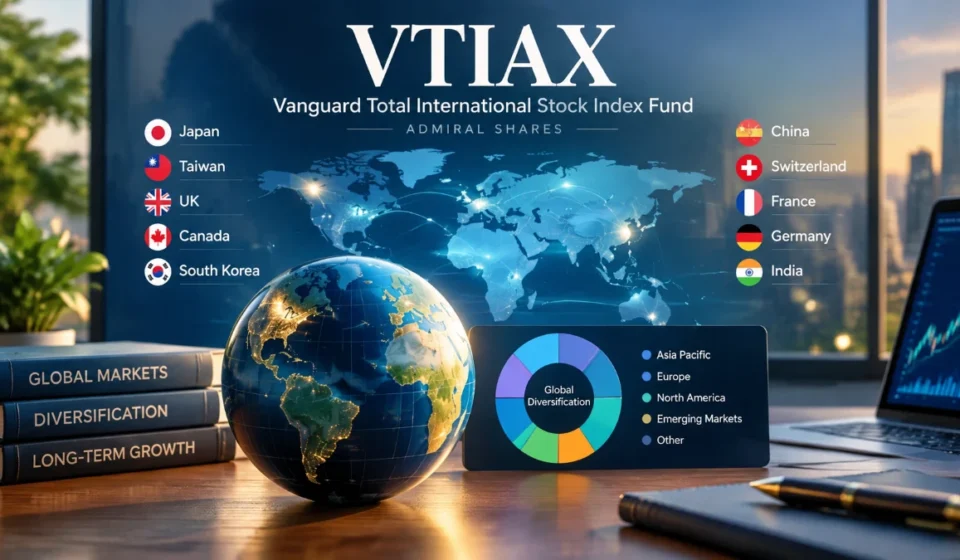
At June 30, 2026, the largest country allocations included Japan at 15.42%, Taiwan at 9.08%, the United Kingdom at 7.59%, Canada at 7.63%, South Korea at 7.49%, China at 6.73%, Switzerland at 5.33%, France at 4.70%, Germany at 4.59%, and India at 4.42%. The fund’s reported U.S. exposure was only 0.88%.
That distribution gives the fund a very different geographic profile from a U.S. total-market fund.
It also explains why “international diversification” does not mean simply adding a few foreign technology stocks. An investor gets exposure to Japanese financial institutions, European pharmaceutical companies, Canadian banks, Taiwanese semiconductor manufacturers, South Korean electronics businesses, and companies in many other industries and markets.
Developed and emerging markets
The benchmark combines developed and emerging markets rather than isolating one category.
That broad mandate gives Vtiax exposure to economies at different stages of development, but it also introduces additional differences in regulation, liquidity, accounting practices, political conditions and market structure.
Emerging-market exposure is therefore not an automatic bonus or a defect. It is part of what makes a genuinely broad international portfolio different from a developed-markets-only fund.
How much does Vtiax cost?
One of the clearest advantages of Vtiax is its low expense ratio.
The current expense ratio is 0.09%, reported by Fidelity as both the gross and net expense ratio as of February 27, 2026. Fidelity translates that into approximately $0.90 per $1,000 invested annually, before considering investment gains or losses.
At a hypothetical $10,000 investment, 0.09% corresponds to about $9 per year in fund expenses.
That does not mean an investor receives a bill for exactly $9. Fund expenses are reflected in the fund’s returns rather than normally being charged as a separate transaction.
Low costs are particularly relevant for a long-term index fund because there is little reason for investors to pay an active-management premium when the strategy itself is designed to track a market index.
Read also: Class Companion: How the AI Platform Works for Teachers and Students
What about the minimum investment?
The minimum can depend on where you purchase the fund.
Vanguard’s direct fund information has historically listed a $3,000 minimum for Admiral Shares, while Fidelity currently lists $2,500 as its minimum-to-invest figure for VTIAX and separately shows a $100 online transaction fee.
That difference is exactly why an article should not present one brokerage’s purchase requirements as though they apply everywhere.
If you are buying through Vanguard, check Vanguard’s current purchase requirements. If you are using another brokerage, check that platform’s fund-specific terms.
Vtiax performance: what the numbers really show
Performance is one of the easiest parts of a fund article to oversimplify.
As of June 30, 2026, Vtiax had average annual total returns of:
| Period | VTIAX | FTSE Global All Cap ex US Index | Foreign Large Blend average |
| 1 year | 27.36% | 26.56% | 21.46% |
| 3 years | 18.68% | 18.41% | 16.72% |
| 5 years | 8.76% | 8.49% | 8.43% |
| 10 years | 9.92% | 9.79% | 9.46% |
These are average annual total returns, not forecasts.
The comparison with the benchmark is particularly useful.
Over those periods, the fund stayed relatively close to the FTSE Global All Cap ex US Index. That is what you would expect from an index fund. The difference between the fund and its benchmark reflects expenses, implementation and other tracking effects rather than an active manager trying to outperform the market.
The category comparison tells another story. Vtiax has recently been ahead of the Foreign Large Blend category average across the displayed periods, but that does not mean the fund is actively beating an index through stock selection. It is primarily benefiting from its broad, low-cost approach and the particular composition of the market it tracks.
Why different websites show different returns
A return without a date is almost useless for a fast-moving financial page.
For example, Fidelity reports a 12.86% daily YTD return as of July 31, 2026, while the quarter-end monthly YTD figure was 13.95% as of June 30. Those are not contradictory; they represent different measurement dates and methodologies.
This is why a strong article about Vtiax should always pair performance figures with an as-of date.
The same rule applies to NAV, holdings, country weights, assets and distributions.
What happened in Vtiax during recent market cycles?
The calendar-year record provides useful context:
| Year | Total return |
| 2020 | 11.28% |
| 2021 | 8.62% |
| 2022 | -16.01% |
| 2023 | 15.52% |
| 2024 | 5.14% |
| 2025 | 32.18% |
| 2026 through June 30 | 13.95% |
The figures above are reported by Fidelity for the fund’s Admiral Shares.
The sequence is more informative than selecting one impressive year.
In 2022, international equities fell sharply. In 2025, they produced a much stronger return. That contrast shows why Vtiax should be evaluated as a long-term equity allocation rather than as a fund whose recent performance can be extrapolated indefinitely.
The fund’s own historical record also demonstrates that international diversification does not mean low volatility. The portfolio contains thousands of companies, but those companies can still fall together when global equity markets weaken.
Vtiax vs. VXUS: which is better?
For many investors, the most important comparison is Vtiax vs. VXUS.
The two products are designed to provide essentially the same broad non-U.S. equity exposure, and both track the FTSE Global All Cap ex US Index. The major practical difference is the wrapper: VTIAX is a mutual fund, while VXUS is an ETF. Vanguard’s current VXUS page lists a 0.05% expense ratio as of February 27, 2026.
| Feature | Vtiax | VXUS |
| Structure | Mutual fund | ETF |
| Strategy | Index | Index |
| Benchmark | FTSE Global All Cap ex US Index | FTSE Global All Cap ex US Index |
| Geographic scope | Non-U.S. developed + emerging markets | Non-U.S. developed + emerging markets |
| Current expense ratio | 0.09% | 0.05% |
| Trading | Priced at NAV once daily | Trades intraday |
| Vanguard minimum shown | $3,000 historically for Admiral Shares | $1 |
| Best fit | Investors who prefer mutual-fund mechanics | Investors who prefer ETF mechanics |
The 0.04-percentage-point expense difference is real, but it is not the only consideration.
A mutual fund can be convenient for automated investing and certain retirement-plan environments. An ETF may be more convenient in a brokerage account where intraday trading, bid-ask spreads and ETF tax mechanics matter.
Neither product should be judged as though one is an entirely different investment strategy. Their underlying international-market exposure is very similar.
Why own an international fund at all?
The strongest argument for Vtiax is not that international markets will beat the United States every year.
They will not.
The argument is diversification across economies, currencies, industries and market valuations.
An investor whose entire equity portfolio is concentrated in U.S. companies is making a geographic allocation whether they intend to or not. Adding international stocks changes that allocation and provides exposure to businesses whose revenue, valuations and economic conditions are not identical to those of U.S. companies.
That can help reduce dependence on one country’s market leadership.
It does not guarantee lower losses.
During a global equity selloff, U.S. and international stocks can decline together. Currency movements can also amplify or reduce a U.S. investor’s return. International markets bring their own political and regulatory risks.
The useful mental model is therefore diversification, not protection.
What are the biggest risks of Vtiax?
Vtiax is an all-equity fund. Its broad diversification does not make it conservative.
Market risk
The fund’s share price can fall substantially when international stock markets decline. Vanguard places the fund at the high end of its risk/reward scale, and investors can lose principal.
Currency risk
Many portfolio companies operate and report in currencies other than the U.S. dollar. Changes in exchange rates can affect the return experienced by a U.S.-dollar investor.
A foreign stock can rise in its local market while the U.S. dollar strengthens enough to reduce the investor’s dollar-denominated return.
Country and political risk
Different countries have different legal systems, regulations, tax policies and political environments. Emerging markets can have additional risks involving liquidity, market infrastructure and disclosure standards.
Concentration by country or sector
Thousands of holdings do not mean every country and industry receives an equal weight.
Japan, Taiwan, the U.K. and Canada are among the largest country exposures, while technology and financial services are the two largest sectors in the June 30, 2026 portfolio data.
Read also: Class Companion: How the AI Platform Works for Teachers and Students
Emerging-market risk
Emerging markets can be more volatile and less liquid than developed markets. They are an important part of the index, but they also increase the range of economic and political environments represented in the fund.
Where can Vtiax fit in a portfolio?
The most natural role for Vtiax is as an international-equity allocation inside a broader portfolio.
One common framework is the three-fund portfolio concept: a U.S. total-stock-market fund, an international-stock fund and a bond fund. VTIAX can fill the international-stock portion of that framework.
But the exact percentage is not universal.
Someone with a long investment horizon and high tolerance for equity volatility may use a different allocation from someone approaching retirement. A workplace retirement plan may also influence the choice because the investor could already have substantial U.S. equity exposure through another fund.
The important question is not “What percentage of VTIAX should everyone own?”
It is:
How much of my overall portfolio do I want invested outside the United States?
Once that decision is made, Vtiax can be evaluated as one possible implementation of that allocation.
Does Vtiax pay dividends?
Yes. Vtiax distributes income generated by its underlying holdings, and its distribution history includes quarterly payments.
The amount can vary considerably because the fund owns companies across many countries with different dividend schedules, currencies and payout policies.
It is also important not to confuse a fund distribution with a guaranteed income stream. An equity fund’s distributions can change, while the fund’s NAV can rise or fall substantially.
For a U.S. taxable investor, foreign taxes are another consideration. The IRS says shareholders of a mutual fund or other regulated investment company may be able to claim a foreign tax credit for their share of foreign income taxes paid by the fund if the fund elects to pass that credit through. The relevant information is generally reported on Form 1099-DIV.
That is more precise than saying every VTIAX shareholder automatically receives a foreign tax credit. Eligibility depends on the fund’s treatment, the account and the applicable tax rules.
Investors should also remember that tax treatment can differ between taxable and retirement accounts. For personal tax decisions, current IRS guidance or a qualified tax professional is the appropriate source.
Vtiax vs. a U.S. total-market fund
This comparison is arguably more important than the VTIAX-versus-VXUS question because the two products do different jobs.
| Question | Vtiax | U.S. total-market fund |
| Primary exposure | Outside the U.S. | United States |
| Market coverage | Developed + emerging non-U.S. | Broad U.S. equity market |
| Main purpose | International diversification | U.S. equity exposure |
| Can one replace the other geographically? | No | No |
| Typical portfolio role | International equity allocation | Domestic equity allocation |
An investor can own both without creating a contradiction.
In fact, the two exposures can complement each other because they cover different geographic portions of the equity market.
The mistake would be to treat Vtiax as a direct replacement for a U.S. total-market fund. Its benchmark specifically excludes the United States.
Who may want Vtiax-and who may not?
Vtiax may make sense for investors who:
- Want broad international equity exposure in one fund.
- Prefer passive index investing.
- Want developed and emerging markets together.
- Value a very low expense ratio.
- Already have U.S. equity exposure and want geographic diversification.
- Have a long enough time horizon to tolerate equity-market volatility.
It may be less suitable for someone who:
- Wants a low-volatility investment.
- Needs predictable income.
- Wants only U.S. stocks.
- Wants concentrated exposure to a particular foreign country or sector.
- Cannot tolerate substantial temporary declines in an equity portfolio.
This is not a question of whether the fund is universally good or bad. It is a question of whether its job matches the portfolio.
Read more: Explore more insightful articles and the latest updates.
What makes Vtiax different from a typical international fund?
The phrase “international fund” covers a lot of different strategies.
Some international funds focus only on developed markets. Others emphasize emerging markets. Some are actively managed and charge higher fees. Others concentrate on large companies or specific regions.
Vtiax takes a broader approach: large-, mid-, and small-cap companies across developed and emerging markets outside the United States, using a market-cap-weighted index.
That breadth is the fund’s defining characteristic.
It means an investor does not need to decide separately how much to allocate to Japan, Europe, Taiwan, India, or emerging markets. The index methodology makes those decisions according to market capitalization.
For investors who want a single broad international allocation rather than a collection of country funds, that simplicity can be valuable.
Frequently Asked Questions
Is Vtiax a stock or a mutual fund?
Vtiax is a mutual fund, specifically Vanguard Total International Stock Index Fund Admiral Shares. It owns a portfolio of international stocks rather than representing ownership in one company.
What does Vtiax invest in?
Vtiax invests in large-, mid-, and small-cap companies in developed and emerging markets outside the United States. Its benchmark is the FTSE Global All Cap ex US Index.
What is the Vtiax expense ratio?
The current reported expense ratio is 0.09%, with both gross and net expense ratios shown at that level as of February 27, 2026.
How many stocks does Vtiax hold?
Fidelity reported 8,826 holdings as of June 30, 2026. The number can change as the portfolio and underlying index change.
What are the largest Vtiax holdings?
As of June 30, 2026, the largest positions included Taiwan Semiconductor Manufacturing, Samsung Electronics, SK hynix, ASML Holding and Tencent Holdings. Their weights change over time.
What countries does Vtiax invest in?
Vtiax invests across many developed and emerging markets. As of June 30, 2026, Japan was the largest country allocation at 15.42%, followed by Taiwan, Canada, the U.K., South Korea and China among the larger exposures.
What is the difference between Vtiax and VXUS?
Both provide broad international stock exposure outside the United States and track the FTSE Global All Cap ex US Index. Vtiax is a mutual fund, while VXUS is an ETF. Vanguard currently lists VXUS at a 0.05% expense ratio compared with VTIAX’s 0.09%.
Does Vtiax pay dividends?
Yes. Vtiax distributes income from its underlying holdings, with distributions varying over time. The fund should not be treated as a fixed-income or guaranteed-income investment.
Is Vtiax risky?
Yes. Vtiax is an equity fund and can lose value when international stock markets decline. It also carries currency, country, political, regulatory and emerging-market risks. Vanguard places the fund at 5 on its risk/reward scale.
Can Vtiax replace a U.S. stock fund?
No. Vtiax specifically tracks an index that excludes the United States. It is generally used to add international equity exposure rather than replace a U.S. equity allocation.
Final verdict: Is Vtiax worth considering?
Vtiax is a straightforward product with a specific job: provide broad, low-cost exposure to stocks outside the United States.
Its strongest characteristics are its scale, breadth, passive strategy and 0.09% expense ratio. With thousands of holdings spanning developed and emerging markets, it can give an investor international exposure without requiring separate bets on individual countries or companies.
The trade-off is equally clear. This is still an equity fund. International markets can decline sharply, currencies can move against U.S. investors, and the fund can lag U.S. stocks for long stretches. Its diversification reduces company-specific concentration; it does not eliminate market risk.
The most useful way to judge Vtiax is therefore not by asking whether it is the “best” international fund. Ask whether you need the exposure it provides, whether you are comfortable with its risks, and whether its mutual-fund structure works for your account.
If the answer is yes, Vtiax is one of the clearest examples of a low-cost international index fund designed to cover a very large portion of the non-U.S. equity market.
Financial data changes. NAV, holdings, country weights, distributions, performance, assets and purchase requirements should be checked against the latest fund documents before making an investment decision. Historical performance does not guarantee future results.