Tokyo Ghoul Manga: Story, Reading Order, Arcs, Characters, Anime Differences, and Ending
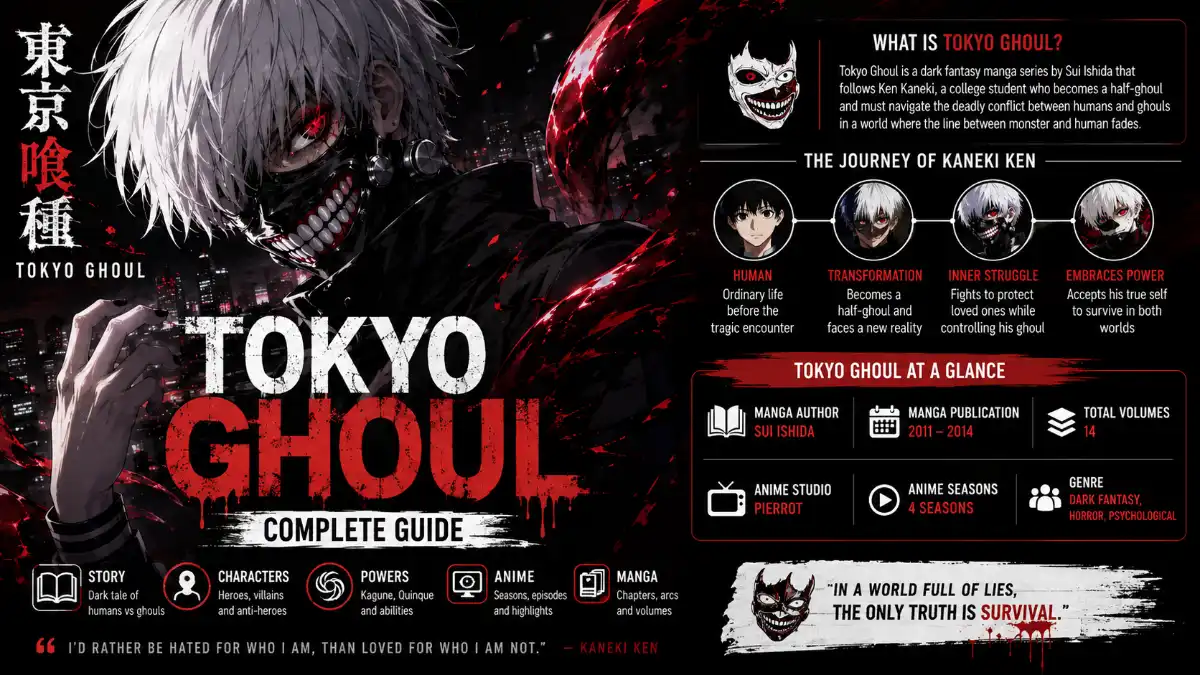
Tokyo Ghoul manga is a completed dark fantasy and horror series written and illustrated by Sui Ishida. It began serialization in Weekly Young Jump in 2011, ended its original run in 2014, and continued through Tokyo Ghoul: re until 2018. The main story spans 322 chapters total – 143 chapters in Tokyo Ghoul and 179 chapters in Tokyo Ghoul: re – for a total of 30 volumes. The correct reading order is Tokyo Ghoul → Tokyo Ghoul: re, and Tokyo Ghoul: re is the direct sequel, not a spin-off.
Tokyo Ghoul Manga at a Glance
| Detail | Information |
| Creator | Sui Ishida |
| Magazine | Weekly Young Jump |
| Genre | Dark fantasy, horror, thriller |
| Original series | Tokyo Ghoul |
| Sequel | Tokyo Ghoul: re |
| Original serialization | 2011-2014 |
| Sequel serialization | 2014-2018 |
| Original volume count | 14 volumes |
| Sequel volume count | 16 volumes |
| Main story chapters | 322 total |
| Original chapters | 143 |
| Sequel chapters | 179 |
| Story status | Complete |
| Original publisher | Shueisha |
| English publisher | VIZ Media |
| Content note | Graphic violence, body horror, disturbing imagery, and psychological trauma |
Read Also: Amazon Prime Movies: The Ultimate Guide to the Best Films
Tokyo Ghoul Manga Reading Order
If you want the main story in order, the sequence is simple.
| Order | Title | Required? |
| 1 | Tokyo Ghoul | Yes |
| 2 | Tokyo Ghoul: re | Yes |
| Optional | Tokyo Ghoul: Jack | No |
| Optional | Tokyo Ghoul: Joker | No |
| Optional | Tokyo Ghoul: Days | No |
| Optional | Tokyo Ghoul: Void | No |
| Optional | Tokyo Ghoul: Past | No |
| Optional | Tokyo Ghoul: re Quest | No |
For the core narrative, read Tokyo Ghoul first and Tokyo Ghoul: re second. The side works add background and extra context, but they are not necessary to understand the main plot or ending.
Side material availability
| Title | Type | English Availability |
| Tokyo Ghoul: Jack | Prequel manga | Official English release available |
| Tokyo Ghoul: Joker | Side story | Official English publication available in a collected edition context |
| Tokyo Ghoul: Days | Novel | Official VIZ English release |
| Tokyo Ghoul: Void | Novel | Official VIZ English release |
| Tokyo Ghoul: Past | Novel | Official VIZ English release |
| Tokyo Ghoul: re Quest | Novel/sidee material | No official VIZ English edition currently listed |
What Tokyo Ghoul Is
Tokyo Ghoul is set in a version of Tokyo where ghouls live hidden among humans and survive by eating human flesh. The series begins with Ken Kaneki’s transformation into a half-ghoul after a date with Rize Kamishiro goes disastrously wrong, and it follows his struggle to survive between two incompatible worlds.
The series is not just a monster story. It uses its horror premise to explore identity, alienation, trauma, prejudice, and the pressure of being forced into a life you did not choose.
Essential Tokyo Ghoul Terms
These terms appear throughout the manga and are useful to know early.
| Term | Meaning |
| Ghoul | A being who looks human but must eat human flesh to survive. |
| Half-ghoul | Someone with both human and ghoul traits, such as Kaneki. |
| CCG | The government organization that investigates and eliminates ghouls. |
| Kagune | A predatory appendage formed from RC cells stored in a ghoul’s kakuhou and used primarily for hunting and combat. |
| Quinque | A weapon made from ghoul parts and used by the CCG. |
| RC cells | Cells present in humans and ghouls, but found at much higher levels in ghouls; they are central to ghoul physiology and kagune formation. |
| Kakuhou | An internal organ that stores RC cells and enables a ghoul to manifest a kagune. |
| Kakuja | A mutated kagune state associated with repeated cannibalism among ghouls. |
| Aogiri Tree | A violent ghoul organization that drives major conflict. |
| Anteiku | A café that functions as a refuge for peaceful ghouls. |
| Quinx | CCG operatives modified to use ghoul-like abilities. |
| One-Eyed Owl | A major identity and symbol tied to the series’ hidden conflict. |
| One-Eyed King | A central symbolic role tied to ghoul leadership and resistance. |
Tokyo Ghoul Story
Kaneki’s life changes after Rize attacks him and doctors save him by transplanting her organs into his body. That accident turns him into a half-ghoul and forces him to learn how to live with a hunger and physiology he never asked for.
From there, the story moves through Anteiku, the CCG, Aogiri Tree, and later the Quinx era in Tokyo Ghoul: re. As the conflict expands, Kaneki is pushed into larger and larger roles until the series becomes a full-scale story about power, memory, and whether coexistence is possible at all.
Tokyo Ghoul Characters
The Tokyo Ghoul manga characters are strongest when viewed by their function in Kaneki’s story. The descriptions below are spoiler-light and focus on each character’s narrative role.
| Character | Affiliation | Role | Why They Matter |
| Ken Kaneki | Central protagonist | Main lead | His transformation drives the entire series. |
| Touka Kirishima | Anteiku | Ghoul ally | A major emotional anchor and key part of Kaneki’s future. |
| Hideyoshi Nagachika | Human | Kaneki’s best friend | Represents Kaneki’s human life and emotional continuity. |
| Rize Kamishiro | Independent ghoul | Catalyst | Her attack starts the plot. |
| Shuu Tsukiyama | Ghoul society | Supporting character | Shows how the series balances menace, obsession, and growth. |
| Koutarou Amon | CCG | Investigator | Adds moral complexity to the human side. |
| Juuzou Suzuya | CCG | Investigator | One of the series’ most distinctive characters. |
| Haise Sasaki | CCG / Quinx era | Central figure in the sequel | Essential to the sequel’s structure. |
| Kishou Arima | CCG | Elite investigator | Central to major revelations in the original series. |
| Eto Yoshimura | Ghoul / One-Eyed Owl | Major power player | Connected to the larger hidden conflict. |
Tokyo Ghoul Arcs
Tokyo Ghoul is commonly divided into story arcs. The chapter ranges below are practical guideposts based on commonly used fan and reference divisions.
Tokyo Ghoul arcs
| Arc | Chapters | Main Focus |
| Introduction | 1-3 | Kaneki’s transformation after meeting Rize. |
| Nishiki | 4-9 | Kaneki encounters Nishiki and learns the basics of survival. |
| Doves’ Emergence | 10-30 | The CCG conflict develops and becomes more visible. |
| Gourmet | 31-42 | Tsukiyama’s obsession escalates into open danger. |
| Aogiri Tree | 43-58 | The violent ghoul organization expands the conflict. |
| Post-Aogiri Tree | 59-79 | The fallout reshapes alliances and Kaneki’s path. |
| Kanou’s Lab | 80-99 | Hidden experiments and manipulation come into focus. |
| Disbanding | 100-121 | Anteiku and surrounding alliances begin to fracture. |
| Owl Suppression Operation | 122-143 | The original series reaches its major large-scale conflict. |
Tokyo Ghoul: re arcs
| Arc | Chapters | Main Focus |
| Torso Investigation | 1-14 | The sequel introduces Haise Sasaki and the Quinx Squad. |
| Nutcracker Investigation | 15-16 | Early sequel stakes and CCG operations sharpen. |
| Auction Mopping-Up Operation | 17-31 | A major rescue and combat operation centered on the ghoul auction. |
| Rose Investigation | 32-50 | The story widens into deeper faction politics and hidden history. |
| Tsukiyama Family Extermination | 51-58 | A major emotional and tactical conflict around the Tsukiyama family. |
| Rushima Landing / Third Cochlea Raid | 59-80 | A large operation shifts the balance of power. |
| Clown Siege / CCG Lab Infiltration | 81-103 | Multiple factions collide,e and the conflict becomes more chaotic. |
| 24th Ward Raid | 104-121 | The story moves toward its final large-scale confrontations. |
| Dragon War | 122-179 | The climax and resolution of the series. |
Tokyo Ghoul vs Tokyo Ghoul: re
The difference between Tokyo Ghoul and Tokyo Ghoul: re is not just chronology. The first series is more intimate and focused on Kaneki’s transformation, while the sequel expands the scale and resolves the story.
| Topic | Tokyo Ghoul | Tokyo Ghoul: re |
| Narrative focus | Transformation and survival | Identity, memory, and closure |
| Tone | Claustrophobic horror and emotional pressure | Larger-scale conflict with political consequences |
| Cast | Smaller ensemble | Expanded cast with Quinx and new factions |
| Reading role | First half of the story | Direct sequel and conclusion |
Manga vs Anime
The manga and anime are not equivalent experiences. The anime introduces many readers to the world, but the manga preserves the complete structure, pacing, and character development.
| Category | Manga | Anime |
| Story continuity | Original canon | Significant alterations |
| Kaneki development | Detailed and gradual | More compressed |
| A storyline | Original manga path | Diverges significantly |
| re-pacing | Full 179-chapter progression | Highly compressed adaptation |
| Completeness | Full source narrative | Altered and substantially compressed adaptation |
If you watched the anime, where should you start?
Start from Chapter 1. Tokyo Ghoul √A changes Kaneki’s post-Aogiri trajectory and rearranges or omits important manga material. Beginning at the start is the safest way to get the intended pacing and character beats.
Why Many Readers Prefer the Manga
Tokyo Ghoul manga works especially well in print because Ishida can use the page to carry ideas the anime cannot fully preserve.
- Kaneki’s internal monologue makes his collapse and recovery feel more immediate.
- Masks, eyes, and fractured faces reinforce the story’s identity themes.
- The artwork becomes more expressive and chaotic as the series intensifies.
- Human-vs-ghoul morality stays ambiguous instead of collapsing into simple good and evil.
- Symbolic repetition across volumes gives the series a stronger long-form payoff.
That combination of psychological narration and visual symbolism is one reason the manga remains so distinctive.
Where to Read Tokyo Ghoul Manga
The official English source for Tokyo Ghoul manga is VIZ Media, which publishes the series in digital and collected print editions. If you want the most reliable reading experience, use official editions for correct translation and chapter order.
Who Should Read It?
Read it if you want psychological character development, moral ambiguity, body horror, symbolism, and long-form payoff.
Skip it if you dislike graphic violence, dense faction politics, large casts, or identity-and-memory-driven storytelling.
Is Tokyo Ghoul Worth Reading?
Yes, if you want a completed dark fantasy series with strong emotional payoff and a clearly finished core story. It is especially rewarding for readers who like a manga that develops from personal horror into a much larger conflict without losing its emotional center.
Tokyo Ghoul Ending Explained
Major Tokyo Ghoul: re ending spoilers below.
The Dragon crisis brings the series to its final turning point. Kaneki survives the last conflict, and the epilogue shows him married to Touka with a daughter named Ichika. That time skip is important because it shifts the ending from mere survival to actual rebuilding.
By the end, the CCG is no longer operating in the same way it did at the start of the series, and human-ghoul relations move toward coexistence rather than total war. The ending is hopeful, but not naive: it does not erase the deaths, trauma, or damage that came before it. Instead, it argues that people shaped by violence can still build a future after it.
Read more: For more in-depth guides and the latest updates, explore more on Vtiax.
How Long Does Tokyo Ghoul Take to Read?
With 322 main-story chapters, the total reading time depends on pace.
- At roughly 10 minutes per chapter, the series takes about 54 hours.
- 5 chapters a day: about 64 days.
- 10 chapters a day: about 32 days.
- 20 chapters a day: about 16 days.
That makes the series long enough to feel substantial, but still manageable for most readers.
Why Tokyo Ghoul Rewards a Second Read
The series becomes richer after you know how it ends. Rize’s role, Arima’s behavior, Haise’s early scenes, and the way Kaneki is framed visually all gain extra meaning once the sequel has recontextualized them.
A second read also makes the recurring imagery easier to spot. Ishida uses masks, eyes, broken identities, and repeated visual contrasts to hint at the story’s deeper structure long before the revelations arrive. That foreshadowing is one of the manga’s biggest strengths.
Sources & Publication Information
- Weekly Young Jump – original Japanese serialization venue for Tokyo Ghoul and Tokyo Ghoul: re.
- Shueisha – Japanese publisher of the original series and sequel.
- VIZ Media – official English publisher and chapter/volume source for the manga.
Frequently Asked Questions
Is Tokyo Ghoul manga finished?
Yes. The story is complete across Tokyo Ghoul and Tokyo Ghoul: re, with no ongoing chapters.
How many chapters does Tokyo Ghoul manga have?
The main story has 322 chapters total: 143 in Tokyo Ghoul and 179 in Tokyo Ghoul: re. Some databases may vary slightly depending on how they count extras.
Is Tokyo Ghoul: re a sequel or a spin-off?
It is a direct sequel, not a spin-off. It continues the main story and contains the ending.
Do I need to read Tokyo Ghoul: Jack or the novels?
No. They are optional side material. The main story is fully understandable without them.
Where should anime viewers start the manga?
Start from Chapter 1. That is the best way to avoid continuity problems caused by the anime’s divergences.
Why does Tokyo Ghoul: re matter so much?
Because it resolves the questions left by the original series, including Kaneki’s final identity, the future of the CCG, and the relationship between humans and ghouls.
Is Tokyo Ghoul manga scary?
Yes. It includes horror, body transformation, violence, and psychological distress, especially in the later arcs.
What makes the manga better than the anime for many readers?
The manga gives more room to internal conflict, symbolism, character growth, and the full storyline without compression.
How does Sui Ishida’s art change throughout Tokyo Ghoul?
It becomes more expressive and chaotic as the story gets darker, which helps reflect Kaneki’s mental state and the instability of the world around him.
Is Tokyo Ghoul still worth reading today?
Yes. It remains one of the most influential dark fantasy manga because of its atmosphere, emotional writing, and the way it handles identity and moral ambiguity.