Full Size Mattress in a Small Room: Space-Saving Tips & Layout Ideas
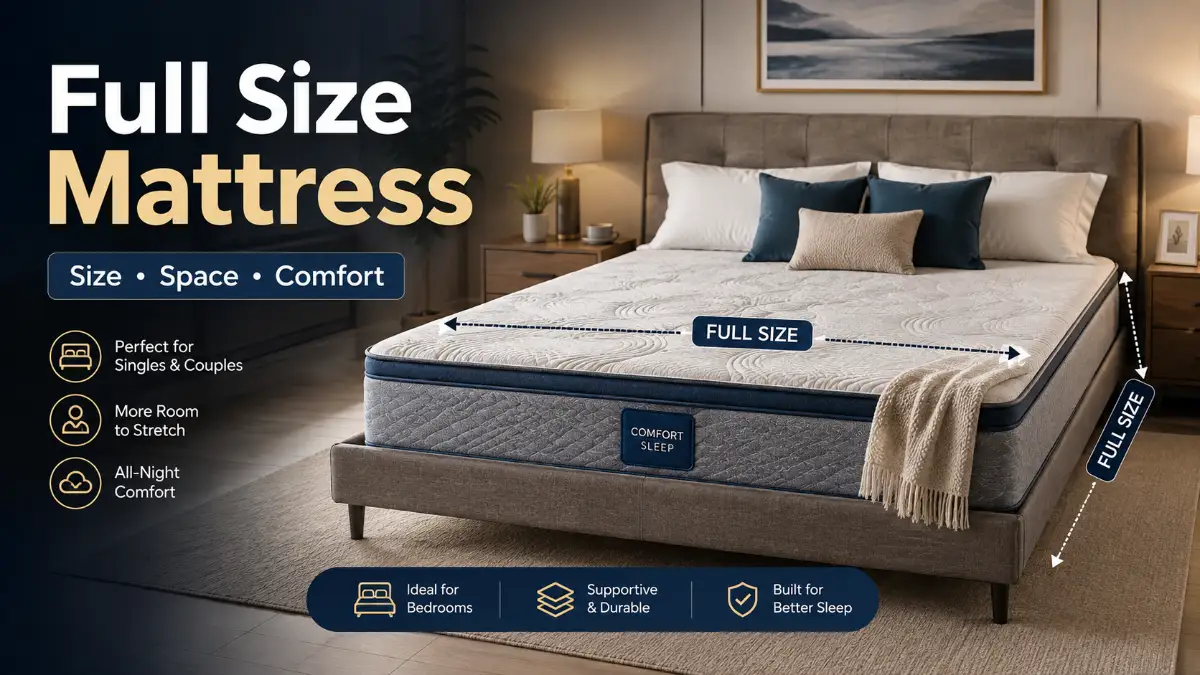
A full size mattress measures 54 inches wide by 75 inches long in the standard U.S. size system. That makes it 16 inches wider than a twin while staying 6 inches narrower and 5 inches shorter than a queen. For a solo sleeper, it can be a useful middle ground: enough sleeping width to stretch out, without taking as much floor area as a queen.
The challenge is that a mattress is not the same thing as a finished bed. The frame, headboard, nightstand, dresser, doors, closets, windows, and walking paths all compete for the same floor space. A full size mattress can fit inside a room and still leave the room frustrating to use if the surrounding clearance is poor.
The best approach is to plan the entire sleeping zone first, then choose the frame and furniture around it. Treat the full size mattress as the starting footprint, not the finished room.
Full Size Mattress Dimensions and Floor Space
The standard full size mattress dimensions in the U.S. are 54 × 75 inches, or 4 feet 6 inches by 6 feet 3 inches. That is 4,050 square inches of sleeping surface, equivalent to about 28.1 square feet. Standard mattress dimensions can vary slightly by manufacturer, so the product specification should be checked before purchase.
Those full size mattress measurements describe the sleeping surface, not the complete bed or the footprint of a frame. Manufacturers can have small dimensional variations, and a bed frame can extend beyond the mattress. Always check the specific product dimensions before buying. Measure the actual full size mattress you buy rather than assuming every model has identical dimensions.
For shoppers focused on full size mattress size in inches, the key starting point is 54 inches by 75 inches.
| Mattress size | Width | Length | Approx. mattress area |
| Twin | 38 in | 75 in | 19.8 sq ft |
| Twin XL | 38 in | 80 in | 21.1 sq ft |
| Full | 54 in | 75 in | 28.1 sq ft |
| Queen | 60 in | 80 in | 33.3 sq ft |
| King | 76 in | 80 in | 42.2 sq ft |
A full size mattress uses about 8.3 square feet more floor area than a twin and about 5.2 square feet less than a queen. That difference can matter when a bedroom also needs a desk, dresser, storage, or open play space.
Plan the Room Around the Full Size Mattress
A common mistake is measuring only the empty rectangle where the mattress will sit. Instead, think about the room as a circulation problem.
Start by measuring the room wall to wall. Then mark the location and swing of the entry door, closet doors, windows, radiators, vents, outlets, and built-in cabinets. After that, draw the bed frame at its actual outside dimensions.
This immediately reveals whether the full size mattress is the real limitation or whether another piece of furniture is consuming the useful clearance. For a full size mattress for small rooms, the most useful measurement is the space left after the bed and essential furniture are placed.
Measure the Bed Frame, Not Just the Mattress
A full size mattress is nominally 54 inches wide, but the frame may be wider or longer. An upholstered headboard can add depth. A footboard can extend the bed toward a dresser. Storage beds may also need clearance for drawers or lifting mechanisms.
When comparing frames, look for the product’s overall width, length, and height. Do not assume that “fits a full size mattress” means the frame has the same dimensions as the mattress.
The same rule applies to foundations and bases. A low-profile platform may keep the footprint close to the mattress, while a decorative frame can occupy noticeably more visual and physical space. Because the full size mattress footprint is fixed, furniture depth often becomes the next major constraint.
Account for Bed Height
Mattress thickness does not change the floor footprint, but it changes how large the bed feels. A tall mattress on a tall foundation can dominate a small bedroom visually.
Height also affects practical details. A taller sleeping surface may require deeper fitted sheets, alter how easily you get in and out of bed, and change how a headboard relates to a window or wall.
For a compact room, consider the total finished height of the full size mattress, foundation, and frame rather than looking at mattress thickness alone.
How Much Clearance Does a Full Bed Need?
There is no universal minimum bedroom size that guarantees a comfortable layout. A room’s shape and furniture placement can matter as much as its square footage.
As a practical planning target, try to preserve roughly 24 to 30 inches of usable space along an accessible side of the bed. Around 30 to 36 inches at the foot can make movement easier, especially when a dresser or desk sits opposite the bed. These are planning guidelines, not building or safety standards.
The important question is what the remaining space can actually do. A well-planned full size mattress layout can leave room for a desk, wardrobe, or open floor area.
You should be able to:
- Walk from the entrance to the bed without squeezing sideways.
- Open the closet and dresser drawers as intended.
- Reach the side of the bed you use every day.
- Change sheets without having to move the entire bed.
- Access windows, outlets, switches, vents, and controls.
- Pull out storage without blocking the main path.
- Leave enough room for routine activities such as cleaning, laundry, and carrying luggage.
If those tasks fail, the room is too crowded even if the full size mattress technically fits.
Read Also: Govee Lights: Discover Stylish Lighting Ideas to Upgrade Your Bedroom & Home Decor
Three Small-Room Layouts to Consider
The right position can make the same full size mattress feel spacious or cramped. Before buying furniture, mark the proposed bed footprint on the floor with painter’s tape or another removable method. If the room is narrow, rotate the full size mattress on your floor plan before buying the frame. Include the frame, not just the mattress.
Headboard Against the Short Wall
In a 10 × 10-foot room, a 54-inch-wide mattress placed across a 120-inch wall leaves 66 inches of total width before the frame and other furniture are considered. If the mattress is centered, that is 33 inches of theoretical space on each side.
Likewise, the 75-inch mattress length leaves 45 inches between the foot of the mattress and the opposite 120-inch wall. A real bed frame can reduce both figures.
This arrangement is often a strong starting point because it creates a conventional sleeping orientation and can leave usable space for bedside tables. The limitation is what you place at the foot of the bed. A deep dresser can quickly consume the remaining pathway.
Bed Against One Long Wall
Pushing one long side of the full size mattress against a wall can open a large area on the other side. This can be effective for a solo sleeper, child, teen, guest room, or studio where floor area has to serve several purposes.
The trade-off is access. The wall-side sleeper has less convenient entry, and changing sheets becomes harder. For two adults, this layout can become inconvenient because one person may have to climb across the other. A full size mattress can be a better choice than a queen when the bedroom must also function as an office.
If you use this arrangement, a low-profile frame and one compact bedside surface can keep the open side useful.
Bed Under a Window
Placing the bed under a window can free another wall for a desk or dresser. But it should be treated as a layout option, not an automatic space-saving trick.
Check whether the window opens, whether curtains need clearance, and whether a radiator or other fixture sits below it. Also make sure the bed does not obstruct a required emergency exit.
A low headboard or headboard-free frame may work better than a tall upholstered design in this position.
Furniture Choices That Make a Small Bedroom Work
A small bedroom benefits from furniture that solves more than one problem without creating new clearance issues.
Use Narrow Bedside Storage
Two oversized nightstands can make a full size mattress feel boxed in. If both sides of the bed need a surface, choose narrow tables, wall-mounted shelves, or simple ledges.
One nightstand can also be enough. In a compact guest room, a small surface for a phone, water, lamp, or book may provide more practical value than a large bedside cabinet.
Choose Dressers for the Whole Opening Zone
A dresser’s published depth is only part of its footprint. The drawers need space to open, and you need space to stand in front of them.
A shallower dresser may work better than a deeper model even if the deeper model has more storage. In a very tight room, a tall chest or better-organized closet can sometimes preserve more floor space than a wide dresser.
Use Vertical Space
When floor area is limited, look upward. Shelving, wall-mounted storage, tall wardrobes, and closet organizers can reduce the need for additional furniture on the floor.
The goal is not to fill every wall. It is to move selected storage functions away from the walking path.
Treat Under-Bed Storage as Usable Space Only If You Can Reach It
Under-bed storage is valuable when the containers can actually be removed. If the bed sits close to a wall, storage drawers on that side may be difficult to use.
A simple raised frame with accessible bins can sometimes be more flexible than a built-in drawer system. Measure the storage opening and the route needed to pull containers out before choosing the bed.
Full vs Queen Mattress: Which Works Better in a Small Room?
The full vs queen mattress decision is mostly a trade-off between sleeping space and floor space. When comparing a full size bed mattress with a queen, measure the room before deciding whether the extra sleeping area is worth the additional footprint.
A full size mattress measures 54 × 75 inches. A queen measures 60 × 80 inches. The queen therefore adds 6 inches of width and 5 inches of length. That may not sound dramatic, but those extra inches can affect side clearance, foot-of-bed clearance, and furniture placement.
For one adult, a full size mattress can provide considerably more width than a twin while remaining more compact than a queen. For two adults, the queen is generally the more practical standard size because it provides more sleeping room.
| If your main limitation is… | Consider | Reason |
| Very narrow room | Twin or Twin XL | Both are 16 inches narrower than a full |
| Tall solo sleeper | Twin XL or another long size | Twin XL is 80 inches long |
| More solo width without a queen | Full | Wider sleeping surface than a twin |
| Two adults sharing regularly | Queen | More width and length than a full |
| Short, wide room | Full or queen | Compare actual furniture clearance |
| Long, narrow room | Twin XL | Preserves more side-to-side space |
A full size mattress is also 16 inches wider than a twin. For shoppers focused on full size mattress size in inches, the key starting point is 54 inches by 75 inches. That extra width can make a meaningful difference for a solo sleeper who wants room to change position without moving up to a queen.
What About a Full XL?
A Full XL is typically 54 × 80 inches, giving it the same nominal width as a full but 5 additional inches of length. It can be useful for a taller solo sleeper who wants the width of a full.
Availability is more limited than standard full or queen sizes, so check mattress, frame, and bedding compatibility before choosing it.
Is a Full Size Mattress Good for a 9 × 10 or 10 × 10 Room?
A full size mattress can work in both room dimensions, but room size alone cannot guarantee a comfortable result.
In a 9 × 10-foot room, the mattress can fit geometrically, yet the remaining floor area may become tight once a frame, dresser, nightstand, or desk is added. In a 10 × 10-foot room, there is more planning flexibility, but the door and closet positions still matter.
For a small bedroom, prioritize the actual clearances over a generic “minimum room size” rule. A simple bed in a well-shaped room can function better than a larger room filled with deep furniture.
How to Make a Full Size Mattress Feel Less Crowded
A small bedroom does not have to look packed. The visual impression depends on both floor area and what the eye sees.
Keep the bed frame relatively simple if the room is already busy. A bulky footboard, oversized headboard, or heavy storage base can make the bed appear larger than its mattress footprint.
Keep major walking paths visually open. Avoid placing several small pieces of furniture around the bed simply because there is a little unused space. One useful bedside table is usually better than two pieces that make circulation awkward.
Also avoid measuring only the empty room. Tape out the bed and the major furniture pieces at their real dimensions. Then walk through the layout. Open the imaginary drawers. Stand where you would make the bed. Check the closet route. This practical test often reveals problems that a basic square-foot calculation misses.
Full Size Mattress Buying Checklist for a Small Room
Before ordering a mattress or bed, check the entire delivery and setup path.
- Measure the bedroom in inches.
- Record door and closet opening directions.
- Mark windows, radiators, vents, outlets, and switches.
- Measure the frame’s exterior dimensions.
- Check the mattress dimensions listed by the manufacturer.
- Decide which side of the bed needs everyday access.
- Measure dresser and nightstand depth.
- Allow space for drawers and cabinet doors to open.
- Check the finished bed height.
- Confirm fitted-sheet pocket depth for the mattress.
- Measure the route into the bedroom, including turns, stairs, hallways, and elevators.
- Plan where luggage, laundry, cleaning supplies, and other everyday items will go.
- Test the proposed layout before buying large furniture.
A mattress delivery can also become a room-planning problem. A mattress may fit the bedroom but fail to make the journey through a narrow stairwell or tight turn. Check the full size mattress delivery path as carefully as the room itself. Measure the delivery path and check the seller’s packaging and handling information before checkout.
Read More: Explore More Smart Home & Bedroom Ideas to Create a More Comfortable Space
Who Should Choose a Full Size Mattress?
A full size mattress is usually most compelling for a single sleeper who wants more width than a twin but does not want the larger footprint of a queen. Standard full mattresses are generally positioned as a single-sleeper size, while queen mattresses are commonly chosen by couples.
The full size mattress for adults is particularly useful when one adult wants more sleeping width without moving to a queen.
It can work particularly well in:
- Small primary bedrooms used by one adult
- Teen bedrooms
- Guest rooms
- Studio apartments
- Multipurpose rooms that also need a desk
- Bedrooms where storage and circulation are priorities
A full size mattress is less compelling when two adults will share the bed every night and the room can accommodate a queen without creating a problematic layout. Saving a few inches of floor space may not justify giving up sleeping width.
Taller solo sleepers should also consider length. The standard full is 75 inches long, so people around or above 6 feet tall may prefer an 80-inch-long option such as a Twin XL, queen, or Full XL depending on the room and sleeping needs.
Frequently Asked Questions
What are full size mattress dimensions in inches?
A standard U.S. full size mattress is 54 inches wide by 75 inches long. It is also commonly called a double mattress.
How much floor space does a full size mattress use?
The mattress surface is about 4,050 square inches, or 28.1 square feet. The actual bed requires more space because the frame and necessary walking clearance extend beyond the mattress.
Is a full size mattress good for a 10 × 10 room?
Yes, it can be a practical choice, especially for one sleeper. But the usable layout depends on the frame, door, closet, dresser, nightstand, and other room features.
Can a full size mattress fit in a 9 × 10 room?
It can fit physically, but that does not guarantee comfortable circulation. The full size mattress should leave enough usable space for the furniture and movement you need. Use the actual room dimensions and furniture measurements to test the layout before purchasing. This is especially important when a full size mattress is replacing a smaller bed.
How much space should be left around a full bed?
A practical planning target is about 24 to 30 inches along an accessible side and roughly 30 to 36 inches at the foot where possible. These are comfort and circulation guidelines, not universal requirements.
Is a full size mattress good for adults?
It can be an excellent choice for a single adult who wants more sleeping width than a twin. Standard full mattresses are 75 inches long, so taller adults may prefer a longer mattress size.
Is a full or queen better for two adults?
A queen is generally the better standard choice for two adults because it is 6 inches wider and 5 inches longer than a full. A full can be used by two people, but sleeping space is more limited.
Should a full bed be against the wall in a small room?
It can work well for one sleeper because it opens floor space on the other side. The disadvantage is reduced access on the wall side and less convenient bed-making.
Does a full bed frame have the same dimensions as the mattress?
Not necessarily. The mattress is nominally 54 × 75 inches, but frame dimensions vary by design. Always check the frame’s exterior measurements before planning a tight room.
Can a full size mattress fit through a bedroom door?
Often, but the answer depends on the mattress construction, packaging, door width, hallway dimensions, turns, stairs, and elevator access. Measure the entire delivery route rather than checking only the bedroom door.