Where to Put a Juniper Bonsai: Care, Placement, and Styling Guide
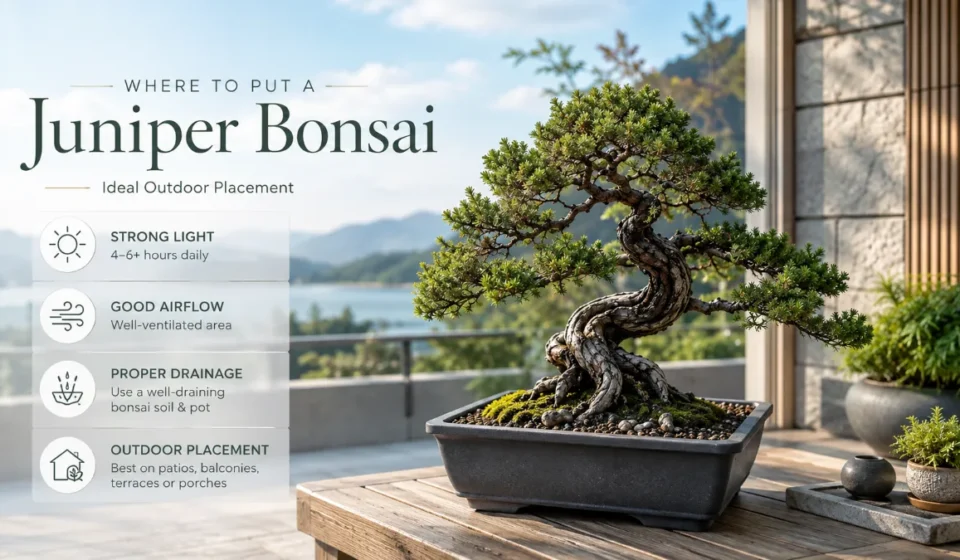
The best place for a juniper bonsai is usually outside, even when your goal is to use it as home decor. Successful juniper bonsai care begins with strong natural light, airflow, proper drainage, and seasonal conditions. The decorating decision comes afterward: once you find the right growing location, you can turn that space into an attractive display.
That changes the usual decorating process. Instead of asking, “Which shelf looks best?” ask, “Which outdoor spot keeps the tree healthy, and how can I make that spot look intentional?”
For patios, balconies, terraces, courtyards, and suitable porches, this approach can produce a much better result than trying to force an outdoor conifer into a living room.
Start With the Growing Environment
A good permanent location should provide:
- Strong natural light
- Good airflow
- Reliable drainage
- A stable surface
- Enough space around the foliage
- Protection from genuinely severe weather
The most important rule is:
Choose the environment first. Design the display second.
This is the central idea behind juniper bonsai care at home.
Location Guide
| Home location | Permanent suitability | Main consideration |
| Sunny patio | Excellent | Watch extreme heat |
| Open balcony | Excellent | Wind and drying speed |
| Sunny terrace | Excellent | Stable support |
| Bright courtyard | Good to excellent | Check actual sunlight |
| Bright porch | Good | Roof may reduce light |
| Deep covered porch | Poor | Usually too shaded |
| Bright indoor window | Temporary | Not a permanent environment |
| Interior bookshelf | Poor | Insufficient natural light |
The actual conditions matter more than the label attached to a location.
Patio: The Easiest Decor-and-Care Combination
A sunny patio can give you the best of both worlds.
Place the tree near an outdoor seating area, on a stable table, or on a low bonsai stand where its trunk and foliage can be appreciated without crowding the space.
Avoid hiding it beneath furniture or placing it where surrounding walls block most direct sunlight.
A raised stand can also keep the pot away from standing water and make the tree more visually prominent.
Balcony: Excellent, but Watch the Microclimate
A balcony can be an excellent permanent location for a juniper.
However, balconies often create conditions that are harsher than gardens:
- Strong wind
- Rapid evaporation
- Hot concrete or metal
- Reflected heat from walls
- Sudden shade from nearby buildings
A balcony that looks bright from inside may receive surprisingly little direct sun once surrounding buildings are considered.
For juniper bonsai care, therefore, assess the actual exposure rather than assuming that “outdoors” automatically means “ideal.”
Courtyard Placement
Courtyards are visually attractive but can be deceptively dark.
Tall walls may block direct light for much of the day. Check the location at different times rather than judging brightness from one visit.
If the courtyard provides strong light and reasonable airflow, the bonsai can become an elegant focal point.
If it is shaded most of the day, it may be better used as a temporary viewing location rather than the tree’s permanent home.
Porch and Entryway Placement
A porch offers an obvious decorating advantage: the bonsai becomes part of the home’s entrance.
But check the roofline.
A deep overhang may make the tree look perfectly positioned while preventing enough direct light from reaching it.
A bright, partially sheltered porch can work. A dark covered porch generally cannot substitute for a sunny outdoor growing position.
Can You Keep a Juniper Bonsai Indoors?
Only temporarily.
Junipers are outdoor bonsai. Bonsai Empire recommends keeping them outside year-round and using cold protection during severe winter conditions.
A short indoor display can be appropriate for:
- A dinner party
- Photography
- A celebration
- A seasonal decorating moment
During the display, use the brightest practical position and keep the tree away from fireplaces, radiators, heating vents, and strong air-conditioning drafts.
How Long Should an Indoor Display Last?
There is no scientifically meaningful universal “maximum number of hours” that guarantees safety. The important principle is that indoor exposure should be brief, while the tree’s normal life remains outdoors.
If you want a bonsai that lives indoors as a permanent decor piece, choose an indoor-suitable tropical or subtropical species instead.
Let Sunlight Decide the Location
Junipers generally prefer full sun or another very bright outdoor environment. General bonsai guidance emphasizes several hours of direct sunlight, but the best exposure depends on climate, season, species, and local conditions.
Compare the Morning and Afternoon Exposure
A useful placement test is to observe:
- When direct sunlight reaches the spot
- When nearby structures create shade
- Whether afternoon heat becomes excessive
- Whether wind is unusually strong
- Whether the tree remains exposed during the growing season
An east-facing location can offer gentle morning sun, while a more exposed position can provide longer direct-light periods. Neither direction is automatically correct everywhere.
Style the Display Around the Tree
Once the growing location is right, look at the tree itself.
Consider:
- Trunk movement
- Canopy direction
- Branch structure
- Foliage density
- Pot shape
- Negative space
- Viewing height
A strong display does not need many decorative objects. The bonsai should remain the visual subject.
Informal Upright
This is one of the easiest styles to integrate into home decor.
It works well with:
- Simple outdoor tables
- Natural wood
- Stone surfaces
- Minimalist arrangements
- Traditional bonsai stands
Leave enough space around the trunk for its structure to remain visible.
Cascade
Cascade designs are especially effective on raised stands because the branches descend beyond the container.
The space below the cascading foliage is part of the composition.
Do not place a large object directly beside the descending branches. Give the movement room to read visually.
Windswept
A windswept bonsai already has strong directional movement.
Its display should emphasize that movement rather than compete with it. Simple surroundings and generous negative space often work better than elaborate decoration.
Deadwood-Focused Junipers
Junipers are well known for dramatic deadwood techniques such as jin and shari. These features can create a weathered appearance that works beautifully as a focal point.
However, advanced styling should be based on the tree’s health and structure, not simply the desire for a dramatic look.
Choosing the Right Pot
The pot has both practical and visual responsibilities.
For an informal upright, an oval or rectangular pot may provide balance. A cascade generally needs a container that supports its downward structure. A windswept tree often looks strongest when the container remains visually quiet.
Traditional proportion rules can help, but they are not laws.
The correct container depends on:
- Tree height
- Trunk thickness
- Canopy width
- Style
- Foliage color
- Pot color
- Overall visual balance
The Drainage Rule
Never sacrifice drainage for appearance.
If you use an outer decorative container:
- Keep the bonsai pot’s drainage holes unobstructed.
- Empty accumulated water.
- Do not let the root container sit in standing water.
- Make sure the complete display remains stable.
A decorative pot that traps water undermines the basic requirements of juniper bonsai care.
Choosing a Bonsai Stand
There is no universal ideal stand height.
Instead, consider the relationship between the tree and the viewer.
A short cascade may need a high stand. A tall upright may look better on a lower surface.
The stand should:
- Support the pot securely
- Leave the trunk visible
- Complement the pot
- Avoid overwhelming the tree
- Provide appropriate viewing height
Wooden stands work naturally in traditional compositions. Minimal dark or neutral stands can suit contemporary outdoor spaces.
These are design choices rather than horticultural requirements.
Placement Changes Your Watering Routine
A major mistake is treating watering as separate from location.
A windy balcony can dry a bonsai much faster than a sheltered courtyard. A shaded porch may retain moisture longer. A rain-exposed terrace may require less manual watering during wet periods.
| Location | Likely effect on moisture |
| Hot sunny balcony | Faster drying |
| Windy terrace | Faster moisture loss |
| Sheltered patio | Moderate drying |
| Cool shaded porch | Slower drying |
| Rain-exposed area | Less predictable manual watering |
These are tendencies, not watering schedules.
Check the substrate and water thoroughly when it has begun to dry slightly. Avoid keeping the roots continuously wet.
Seasonal Placement
The best outdoor position can change temporarily during environmental extremes.
Summer
If extreme heat is stressing the tree, temporary afternoon protection may help. Maintain strong light and airflow rather than moving the tree permanently indoors.
Autumn
Monitor moisture as temperatures change. Begin preparing the most sheltered suitable outdoor location for severe winter conditions.
Winter
Junipers require a cold seasonal period, but shallow bonsai containers expose roots to more severe temperature changes than roots in the ground.
Bonsai Empire recommends winter protection below approximately 15°F (-10°C). Treat this as a guideline rather than a universal survival line because species, acclimation, wind, moisture, and container exposure all matter.
A cold frame or sheltered outdoor location can protect without replacing winter with a heated room.
What If the Placement Is Wrong?
The tree may give you clues.
Foliage Becomes Sparse
Insufficient light is one possibility. Dense foliage pads can also shade interior growth.
Juniper specialists recommend thinning dense pads and fanning foliage so light and air can reach inner growth.
Soil Stays Wet
Check drainage.
If the substrate remains saturated for prolonged periods, inspect the container, soil structure, and watering routine. Excess moisture can deprive roots of oxygen and contribute to root disease.
Foliage Turns Brown
Do not immediately blame the location.
Brown foliage can have multiple causes, including twig blight, root problems, scale, winter injury, and other stresses.
Read more: Where to Put a Juniper Bonsai: Care, Placement, and Styling Guide
White Spots or Scale Appear
Juniper scale can appear as small white coverings on foliage and may cause yellowing, browning, and branch dieback when severe.
Identify the pest before choosing treatment.
A Better Home-Decor Formula
For most homes, the strongest arrangement is:
Healthy outdoor location + appropriate pot + simple stand + negative space + occasional indoor display
You do not need numerous accessories.
The trunk, foliage, container, and space around the tree can provide the visual composition.
That is why the best juniper bonsai care strategy for home decor is not about making the tree adapt to the room. It is about making the outdoor growing space feel intentional.
Frequently Asked Questions
Where is the best place to keep a juniper bonsai?
A bright outdoor location such as a sunny patio, open balcony, terrace, or suitable porch is generally best. Evaluate actual light, airflow, drainage, and local weather.
Can a juniper bonsai stay on a balcony?
Yes. A balcony can provide excellent conditions if it receives strong light and the tree is protected from extreme heat, wind, and cold when necessary.
Can I keep a juniper bonsai on a porch?
Yes, if the porch receives substantial direct light. A deeply shaded porch is generally unsuitable as the permanent growing location.
Can a juniper bonsai be kept indoors for decoration?
Yes, briefly. Keep the indoor visit short and return the tree to its normal outdoor environment afterward.
How much sunlight does a juniper bonsai need?
Junipers generally prefer full sun or another very bright outdoor position. Several hours of direct light is a useful general guideline, but climate and species matter.
Should I rotate my juniper bonsai?
Periodic rotation can help distribute directional light, particularly when one side receives significantly more exposure. It will not instantly correct established uneven growth.
What should I put under a juniper bonsai?
Use a stable surface or bonsai stand that supports the pot securely and does not interfere with drainage.
Which style works best on a raised stand?
Cascade is particularly well suited because its descending structure benefits from elevation. Windswept trees can also work well with sufficient negative space.
Can I use an outer decorative pot?
Yes, provided it does not obstruct drainage or allow water to accumulate around the bonsai container.
Why is my juniper bonsai struggling after I moved it?
A new location can change light, temperature, wind, and drying speed. Reassess the complete environment instead of assuming the move itself is the only cause.
Final Takeaway
The smartest juniper bonsai care strategy for home decor is to reverse the normal decorating process.
Do not start with the room and ask how to keep the tree alive there.
Start with the tree. Find the outdoor location where it receives the light and conditions it needs. Then build the display around that location.
Use the pot and stand to emphasize the tree’s natural form. Keep the surroundings uncluttered. Adapt placement during extreme weather. Bring the tree indoors only briefly when you want it to become part of an interior scene.
That approach gives you something better than a decorative plant: a healthy bonsai that genuinely belongs in the space you’ve created for it.