PS5 Controller Drift: Repair, Replace, or Upgrade?
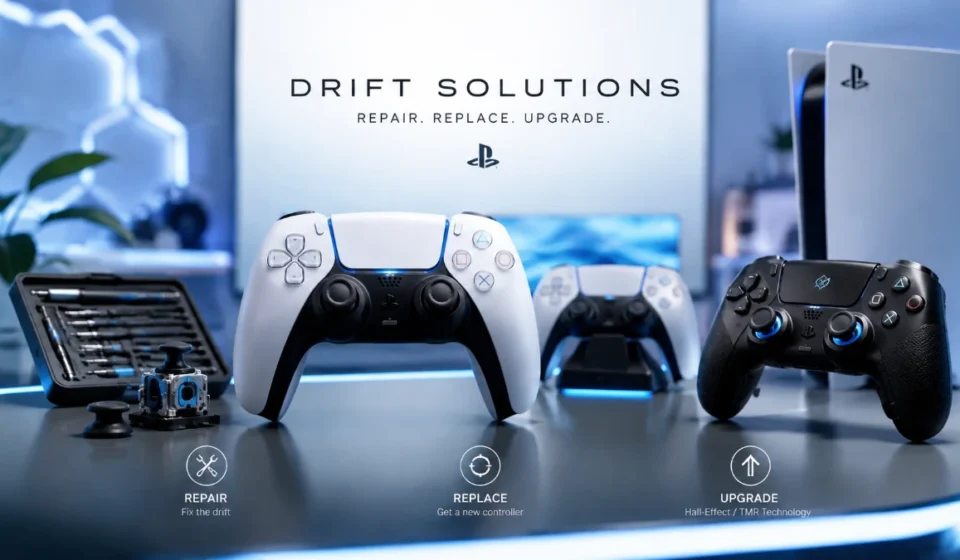
When PS5 controller drift has survived the basic troubleshooting steps, the question changes. You are no longer asking, “What quick fix should I try?” You are deciding whether the controller is worth repairing, whether Sony should handle it, whether buying another DualSense makes more sense, or whether this is the right time to move to a more repairable or drift-resistant controller.
The best choice depends on four things: warranty status, controller condition, repair skill, and long-term priorities.
A cheap replacement part is not automatically a cheap repair. Likewise, buying an expensive controller is not automatically a better solution. The smartest option is the one that gives you the most reliable controller life for the least overall risk and expense.
First, make sure the PS5 Controller Drift really needs repair
Do not base the decision on a single game.
If the character moves by itself only in one title, check that game’s deadzone and sensitivity settings before spending money. If the same stick produces unwanted movement across multiple games and continues doing so after a reset and software update, a controller-level hardware problem becomes more plausible.
Sony’s current DualSense support guidance recommends updating the device software, resetting the controller if problems persist, and using PlayStation Repairs if troubleshooting doesn’t resolve the issue.
Once those steps have failed, the repair-versus-replace decision becomes much more meaningful.
Option 1: Use Sony support before opening the controller
If your controller may still be covered, check the applicable regional warranty or guarantee before attempting a DIY repair.
This is important because Sony’s terms can restrict coverage where a product has been opened, altered, or repaired outside an authorized service facility. For example, Sony’s India guarantee documentation says claims can be rejected where there is evidence of an attempt to open the casing or unauthorized repair or alteration.
Do not generalize one country’s warranty terms to every PlayStation market. Warranty periods, service arrangements, and consumer rights vary by region.
Why official service can be the best value
Official service has an advantage that a cheap joystick module cannot provide: lower personal repair risk.
You do not have to:
- identify the correct internal revision;
- buy soldering equipment;
- desolder a joystick;
- protect the circuit board;
- troubleshoot a repair that went wrong.
Sony’s DualSense support page directs users to PlayStation Repairs when resetting and other troubleshooting steps do not resolve a controller issue.
If the controller is eligible for coverage, there is even less reason to gamble on a DIY repair before checking the official route.
Option 2: Repair the standard DualSense yourself
A standard DualSense can be repaired, but its internal joystick is not designed as a simple user-replaceable module.
iFixit’s current repair documentation describes replacing a drifting DualSense joystick as a soldering repair and specifically warns that desoldering the joystick module is difficult. Its replacement-part documentation also shows that compatibility can depend on the controller’s internal revision.
That makes DIY repair most suitable for people who already have electronics experience.
The real cost of DIY repair
Imagine a replacement joystick costs relatively little.
That does not mean your repair cost is equally small.
You may also need:
- a suitable soldering station;
- desoldering equipment;
- flux and solder;
- opening tools;
- time;
- a compatible replacement module;
- the confidence to work around a delicate circuit board.
A beginner’s failed soldering attempt can cost much more than the original repair.
So the correct calculation is:
Part cost + tools + time + failure risk
rather than simply:
Part cost
Check the controller revision first
Sony provides model-number information for DualSense controllers, and the model number is printed on the back of the controller.
iFixit also lists replacement-part compatibility by model and motherboard revision.
That means you should identify your exact controller before ordering an internal joystick or alternative module.
“Fits PS5 DualSense” is not enough information for a careful repair purchase.
Option 3: Pay a professional repair shop
A reputable repair technician can occupy the middle ground between Sony service and DIY.
This can make sense when:
- the controller is out of warranty;
- the rest of the controller is in good condition;
- you do not have soldering skills;
- the repair price is comfortably below replacement cost;
- you want to preserve a controller you already like.
The key word is reputable.
Ask what component is being replaced, whether the technician supports your controller revision, and what warranty they provide on the repair. Avoid choosing purely on the lowest quoted price.
A professional repair is particularly attractive when you have an otherwise healthy controller and the joystick is the only significant problem.
Option 4: Buy another standard DualSense
Replacement is often the easiest option, and sometimes it is the most rational one.
If your controller is old and has several other problems-such as worn buttons, trigger issues, battery degradation, or physical damage-repairing one joystick may not provide good overall value.
A new standard DualSense gives you a fresh controller, but it does not fundamentally change the sensing technology used by the conventional analog sticks.
That means a new controller should be viewed as a replacement for the current unit, not a guarantee against future stick wear.
When replacement wins
Replacement becomes more attractive when:
- several components are already worn;
- you need a dependable controller quickly;
- you do not want to perform electronics repair;
- professional repair costs approach replacement cost;
- the controller has suffered significant physical or liquid damage.
The decision should consider the whole controller rather than the drifting stick in isolation.
Option 5: Upgrade to a DualSense Edge
The DualSense Edge is a different proposition because Sony designed its stick modules to be replaced separately.
Sony’s official instructions show a release mechanism for removing the stick module and installing a new one. The left and right modules are interchangeable.
That gives the Edge a major ownership advantage:
A future stick-module failure does not require the same soldering-based replacement procedure used for a standard DualSense.
However, do not buy the Edge because you believe it is immune to drift.
iFixit’s teardown analysis identifies the Edge’s stick modules as potentiometer-based. The advantage is modular repairability, not elimination of the traditional contact-based sensing mechanism.
What the Edge is actually buying you
You are paying for more than a replacement stick.
The Edge is attractive to users who value:
- replaceable stick modules;
- customization;
- a premium controller design;
- easier future stick maintenance;
- advanced controller features.
If your only objective is eliminating conventional potentiometer wear, the Edge is not automatically the most technically appropriate answer.
Option 6: Consider Hall-effect or TMR technology
Hall-effect and TMR joystick systems use magnetic sensing rather than the same physical resistive-contact mechanism used in traditional potentiometer sticks.
That makes them attractive to users who specifically want to reduce exposure to the contact-wear mechanism associated with conventional analog sticks.
But avoid the phrase “drift-proof” as a guarantee.
A different sensing technology can still have other mechanical, electrical, calibration, or manufacturing problems.
A better question is:
Does this controller avoid the particular wear mechanism I am trying to eliminate?
For Hall-effect and TMR sticks, the answer is generally yes for traditional potentiometer contact wear.
The remaining questions are compatibility, features, quality, warranty, and long-term support.
Repair vs replacement: the practical comparison
| Route | Technical skill | Upfront cost | Main benefit | Main risk |
| Sony service | None | Depends on coverage/region | Official support | Terms and pricing vary |
| Professional repair | None | Varies | Skilled repair without DIY risk | Technician quality |
| DIY DualSense repair | High | Usually lower part cost | Potentially economical | Board/component damage |
| New DualSense | None | Higher | Fast and simple | Same general stick technology |
| DualSense Edge | Low for module replacement | Higher | Easy future module replacement | Higher purchase price; not drift-proof |
| Hall-effect/TMR alternative | Usually low | Varies | Avoids traditional contact wear | Feature and compatibility differences |
This table reveals why there is no universal winner.
A covered controller favors official service.
An older but otherwise excellent controller can favor professional repair.
A technically skilled owner may favor DIY.
A heavily worn controller can favor replacement.
A long-term owner who values module replacement may favor the Edge.
A user primarily concerned with traditional potentiometer wear may prefer a reputable Hall-effect or TMR design.
The “total ownership cost” is more useful than sticker price
Suppose a controller is otherwise excellent.
Throwing it away because of one replaceable component may be wasteful.
Now consider a controller with several failing components. Paying to replace one joystick may only postpone the next repair.
This is why controller age and condition matter as much as the drift itself.
A useful decision model is:
Repair if the controller is otherwise healthy.
Replace if multiple components are aging.
Use official service first if coverage may apply.
Upgrade when the new controller solves a broader problem you actually have.
That last point matters. Do not buy a premium controller simply because one standard controller developed drift.
Standard DualSense vs DualSense Edge vs Hall-effect/TMR
| Feature | Standard DualSense | DualSense Edge | Hall-effect/TMR alternative |
| Replaceable stick module by Sony’s design | No | Yes | Depends on model |
| Conventional potentiometer stick sensing | Yes | Yes | Generally no |
| Soldering required for standard internal joystick replacement | Yes | No for official module swap | Depends on product |
| Designed for easier future stick replacement | No | Yes | Depends on model |
| Traditional potentiometer contact-wear mechanism | Yes | Yes | Generally avoided |
| Best reason to choose it | Standard PS5 experience | Repairability/customization | Reduced reliance on potentiometer sensing |
Sony’s Edge documentation confirms the replaceable-module design. iFixit’s teardown independently identifies the Edge stick modules as potentiometer-based.
That combination makes the distinction unusually clear: Edge is the repairability upgrade; Hall-effect/TMR is the sensing-technology alternative.
Read more: PS5 Controller Drift: Repair, Replace, or Upgrade
What should you choose?
Choose official Sony service when:
Your controller may still be covered, and you want the lowest personal repair risk.
Choose professional repair when:
The controller is worth keeping, but you do not have soldering skills.
Choose DIY repair when:
The controller is out of coverage, you have suitable equipment, and you already know how to perform board-level soldering.
Choose another standard DualSense when:
The current controller is old, heavily worn, or otherwise not worth repairing.
Choose DualSense Edge when:
You value Sony’s premium controller features and want future stick modules to be replaceable without soldering.
Choose Hall-effect or TMR when:
Your primary objective is to move away from the traditional potentiometer contact-wear mechanism, and you are comfortable evaluating third-party or alternative controller compatibility.
Frequently Asked Questions
Is it cheaper to repair or replace a drifting PS5 controller?
There is no universal answer. Official service can be the best option when coverage applies. Professional repair may make sense for an older controller in good condition, while replacement is more attractive when several components are already worn.
Should I open my DualSense if it might still be under warranty?
Check the applicable regional warranty or guarantee first. Sony’s India guarantee documentation states that unauthorized opening or repair can affect guarantee eligibility. Other markets have their own terms.
Is DIY DualSense joystick replacement difficult?
Yes. iFixit’s current repair guide describes the procedure as requiring intermediate soldering skills and difficult desoldering.
Does the DualSense Edge permanently solve drift?
No. Its major advantage is replaceable stick modules. iFixit identifies the Edge modules as potentiometer-based, so modularity should not be confused with immunity from potentiometer wear.
Can I replace a DualSense Edge stick module myself?
Yes. Sony provides instructions for releasing and replacing the module, and the left and right modules are interchangeable.
Are Hall-effect controllers completely drift-proof?
No. They avoid the traditional physical contact mechanism of potentiometer sensing, but other mechanical or electronic failures can still occur. “Drift-resistant” is a more defensible description than “failure-proof.”
Should I buy a new DualSense after one controller drifts?
Not necessarily. If the existing controller is otherwise healthy, repair may offer better value. If it is old or has several problems, replacement can be more sensible.
Does a cheap joystick module mean a cheap repair?
No. Tools, labor, compatibility, and the risk of damaging the board all affect the real repair cost. Part price alone is an incomplete comparison.
How do I check which DualSense model I have?
Sony says the model number is printed on the back of the controller. It also provides a way to view the controller’s serial number through PS5 settings.
What is the best long-term option for heavy users?
There is no universal winner. The Edge offers easier official module replacement, while reputable Hall-effect or TMR controllers can avoid traditional potentiometer contact wear. Choose based on the PS5 features, compatibility, and repairability you actually need.
Final Verdict
PS5 controller drift does not automatically mean you need a new controller.
If the controller may still qualify for official service, check that route first. If it is older but otherwise healthy, professional or skilled DIY repair can make sense. If several components are deteriorating, replacement may be the better financial decision.
The DualSense Edge occupies a different category: its replaceable stick modules make future stick repairs easier, but they do not make the controller immune to drift. Hall-effect and TMR alternatives address the problem from another direction by avoiding the traditional potentiometer contact-wear mechanism.
The best decision is therefore not the cheapest part or the most expensive controller.
It is the option that gives you the lowest total cost, acceptable risk, and the longest useful service for the way you actually play.